


This brief proposes that access by airlines to emission allowances from other sectors should gradually be reduced.
Aviation was included in the EU’s Emissions Trading System (ETS) in 2012, initially covering all flights departing from the EU, then restricted to intra-EU flights from 2013 onwards. Ever since, aviation has failed to stay within its carbon budget, emitting more CO2 than its allocated allowances, except in 2020-21 due to Covid-19. In 2024, aviation exceeded its carbon budget by 119%, at 62 million tonnes of CO2.
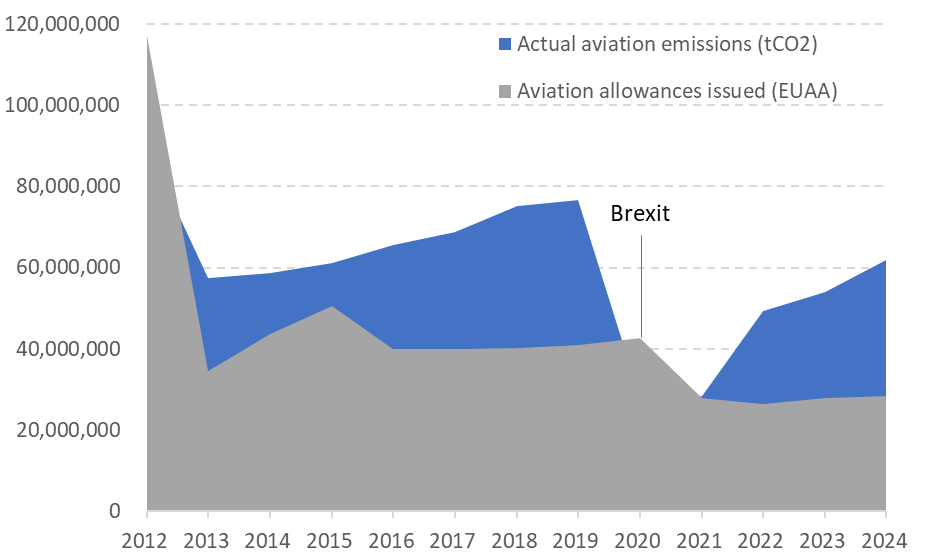
Aviation has so far complied with its EU ETS obligations thanks to the possibility for airlines to surrender “straight” allowances (EUA) alongside aviation allowances (EUAA), to fill their deficit. In 2025, aviation allowances were abolished and only EUAs are now issued for both aviation and other sectors. But the imbalance between aviation and other sectors remains, making aviation an increasingly large net buyer of allowances from other sectors.
We propose that access by airlines to allowances from other sectors should gradually be reduced.
EUA demand take-off
We estimate that aviation’s net demand has been 248 million EUAs over 2012-2025. In the next decade, aviation’s net demand will greatly depend on the sector’s decarbonisation, as illustrated by the table below. The table gives the net aviation demand corresponding to each of the emissions scenarios (S1, S2 and S3) used in the impact assessment (IA) published by the European Commission in 2024 as part of the EU Climate Law, to which we added a scenario where emissions simply remain constant between 2024 and 2040.
These figures do not account for the Commission’s proposal to extend the ETS to extra-EU flights within a 5000-kilometer radius, because the impact of that proposal on market balance depends on many factors and in some cases would not be significant.

(Source: Sandbag)
In the IA’s scenarios, aviation emissions are reduced by at least half compared to their 2024 level. In these cases, the sector’s net demand is between 261-283 million over 2031. However, given the lack of incentives to curb emissions in the current regime, the constant emissions scenario is not unrealistic. Intra-EU flights would then be responsible for 22% of overall ETS emissions. In this case, aviation net demand would total 503 million EUA over 2031-40.
This is more than twice the 2040 cap set at 243 million tCO2 under the Commission’s proposal. It is also a large share of the surplus (EUA in circulation + in reserves) expected under different option designs, as illustrated in the following table [1].

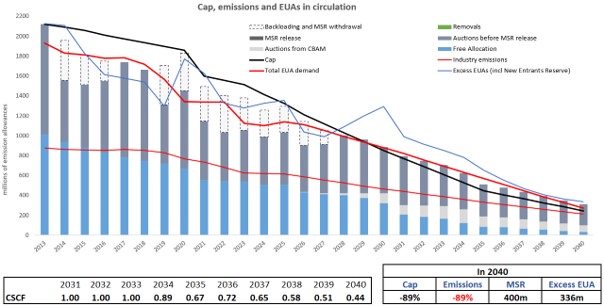
Figure 1: Supply and demand for EUAs in scenario S2, under the Commission’s proposed cap (Source: Sandbag’s EU ETS Simulator)
Figure 1 represents the supply and demand balance under emissions scenario S2, assuming the Commission’s proposed cap and leaving other design options unchanged. The surplus is 736m allowances at the end of 2040, including 400m in the MSR. In Figure 2, net EUA purchases by airlines are linearly reduced from about 30 million in 2030 to zero in 2040. The ETS surplus increases to 869 million EUAs, including 400 million in the MSR.
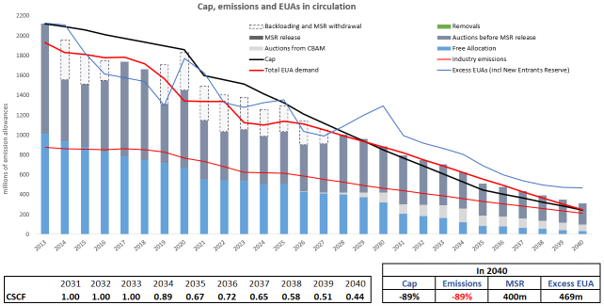
Figure 2: Supply and demand if aviation’s annual access to EUAs linearly drop from 30 million to zero between 2030 and 2040 (Source: Sandbag’s EU ETS Simulator)
Flying economy
By purchasing emission allowances from stationary installations, airlines essentially offload the decarbonisation burden onto (mainly) industry sectors. The extra demand created by airlines drives prices up for those other sectors. The large uncertainty over the share of aviation in tomorrow’s EU ETS, including its possible extension, creates additional risk for industrial sectors exposed to international competition.
In contrast, for the aviation sector, buying allowances is cheaper than reducing emissions. The sector’s unlimited access to allowances acts like an abatement deterrent, making decarbonisation the least economical option. Decarbonisation options such as the use of e-fuels are notoriously expensive, with estimates as high as €500 per tonne of CO2 reduced [2]. In comparison, EUAs cost only about €80 for 1 tonne of CO2. Transfer to rail transport is also expensive, as train ticket prices are sometimes several times more expensive than air fares for equivalent journeys within Europe. In contrast, the relative cost of EUAs on air fares on some destinations was estimated as only 0.9% [3].
For the EU ETS to trigger any meaningful air travel decarbonisation, allowance prices would therefore need to reach levels several times higher than what they are now.
Luckily, unlike industrial goods, air transport is not importable, so increasing emission allowance prices for air transport would not unfairly favour foreign competitors offering similar services. The Commission’s proposed extension of the EU ETS to international flights would not change this analysis, as the extension would create virtually no carbon leakage risk [4].
At high allowance price levels, substitution by ground transport might happen. But such activity, which relies more on domestic infrastructure and less on fuel imports, would be more beneficial to the EU’s economy.
High allowance prices for aviation would raise more funds. These funds could be invested in e.g. rail infrastructure, which would reduce the cost difference between air and rail transport. A better rail network would help the EU to catch up with China’s competitive transport system.
Bringing back EUAA
Restricting access by airlines to stationary allowances can be done in a number of ways. One possibility is to resume the issuance of EU Aviation Allowances (EUAAs) for aviation and allow airlines to cover their emissions using EUAAs plus a limited percentage of EUAs.
Such restriction would effectively create two distinct markets for EUA and EUAA, allowing EUAAs to trade at much higher prices than EUAs: EUAA prices would be driven by the marginal cost of air travel abatement necessary to meet a reduced carbon budget, whereas EUAs would trade at lower prices than if keeping unlimited access to airlines.
Footnotes:
[1] Sandbag (2026), EU ETS review: impacts on the market balance
[2] Based on prices of €800 fuel cost and 3.15 tonnes of CO2 emitted per tonne of kerosene used vs. €2500 for e-kerosene.
[3] CE Delft (2026) EU ETS scope expansion for aviation – Effects on ticket prices and demand
[4] Transport & Environment (2023), ‘Flying via Istanbul: escaping climate measures?’
Related publications
August 11th 2026
June 10th 2026
June 9th 2026
More on the EU ETS
EU ETS review: impacts on the market balance
In this brief, we analyse how the proposed changes will impact the supply and demand balance of the emission allowance market.
Sandbag responds to Thyssenkrupp
Our technical brief on how the ETS is a net benefit for European steelmakers was covered by ESG.Table, alongside a response from Thyssenkrupp Steel, which raised three objections. This response analyses the German steelmaker’s claims.
EU steelmaking: the ETS money is coming!
This brief challenges recent industry claims that EU steelmakers are being harmed by the EU’s Emissions Trading System and finds that the opposite is true.

EU ETS Reform: Let’s not invalidate climate policy!
Based on our updated EU ETS simulator, this technical brief models the impact of the several proposals on the carbon market’s supply/demand balance under the European Commission’s impact assessment emission scenarios.
Improving EU ETS benchmarks: Response to the European Commission’s public consultation on EU ETS benchmarks
Sandbag’s response to the public consultation on the European Commission’s proposed revision of the benchmark values of free allocation of emission allowances (2026-2030).
Rhetoric vs reality: setting the record straight on the impact of the EU ETS on industrial competitiveness
This brief examines whether the claims by Czechia and Italy that the EU ETS is responsible for declining industrial competitiveness hold up to scrutiny.
Don’t Ruin the EU ETS! Joint NGO Letter to the European Council
Ahead of the March European Council meeting, we’ve joined a group of 35 civil society organisations calling on EU leaders to protect the integrity of the EU Emissions Trading System.
ICC reform and expansion risks diverting ETS revenues from real climate action
Sandbag and 14 other organisations urge the European Commission to reform, not expand, the ETS Indirect Cost Compensation scheme — warning that current proposals risk diverting climate funding into untargeted fossil subsidies.
State Aid for Indirect Carbon Costs: Reform before extending!
Sandbag responds to the EU’s consultation on State aid for Indirect Carbon Costs (ICC), calling for targeted reforms to better support clean electricity, avoid windfall profits, and align with the Carbon Border Adjustment Mechanism (CBAM).
Simulating CDR in the EU ETS: The Risks of Premature Integration
Sandbag has developed an ‘ETS + CDR simulator’ to help visualise and explore the impact that CDR integration could have on the ETS, assess the demand it could create for CDR, and highlight the potential consequences of this demand. This report uses the simulator to explore how different integration pathways could affect emissions reductions, carbon prices, and potentially lead to negative externalities.