

On 17 July, the European Commission published its review of the EU Emissions Trading System.
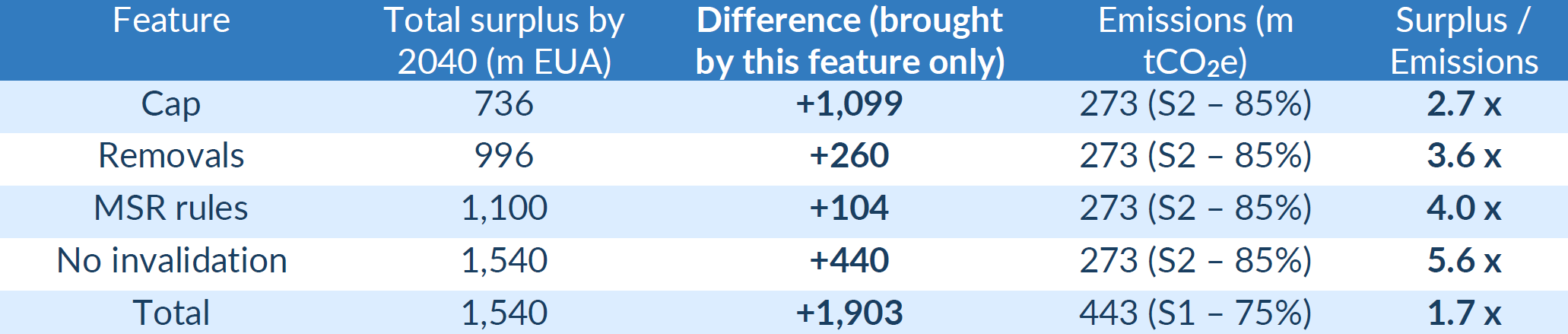
In this brief, we analyse how the proposed changes will impact the supply and demand balance of the emission allowance market. The measures with significant impact are (1) raising the cap, (2) issuing up to 260 million allowances to purchase carbon removals, and (3) changing the rules governing the Market Stability Reserve (MSR).
This brief is based on a small number of selected combinations of design options, whereas the full scope of combinations can be explored on our updated EU ETS Simulator. Supply and demand numbers are given based on the emissions scenarios described by the impact assessment published by the European
Commission in 2024 as part of the EU Climate Law:
- Emission scenario S1: 75% reduction in EU-wide emissions by 2040 [1] (ETS sectors: -81%) [2]
- Emission scenario S2: 85% reduction in EU-wide emissions by 2040 (ETS sectors: -89%)
- Emission scenario S3: 95% reduction in EU-wide emissions by 2040 (ETS sectors: -93%)
The Impact Assessment provides emission breakdowns between power, industry, aviation, and shipping sectors. We translated these into forecasts for the sectors covered by the EU ETS, using short-term production forecasts from major business associations and drawing linear trajectories from short-term values to 2040 in the relevant sectors.
Having updated Sandbag’s ETS Simulator with the latest (preliminary) emissions data, we found that the EU ETS ended 2025 with a total surplus of 2,190 million EUAs, which was brought down to 1,902m surplus allowances, after 270m allowances from the MSR were invalidated on 1 January 2026. This is 1.7 times the level of emissions covered by the scheme in 2025, estimated at 1,139m tCO2.
The surplus breaks down as follows:
- 874m allowances in circulation; [3]
- 486m in the New Entrants Reserve;
- 117m unallocated allowances carried over from previous years;
- 25m in the Greece fund; and
- 400m in the MSR.
We calculated excess EUAs as the sum of allowances in circulation and the New Entrants Reserve (NER), as it is likely that unallocated NER amounts will eventually reach the market, for example through the Investment Booster proposed by the European Commission. We therefore assumed that all amounts locked in the NER will gradually be “in circulation” [4]. The total surplus amount includes excess EUAs as well as allowances locked up in other reserves, i.e. only the MSR in 2040.

Sandbag’s ETS Simulator was updated to include the main design features proposed by the Commission, except for extensions (e.g. to international flights and waste incinerators), the net effect of which should be small as they add both demand and supply to the market.
Summary
The combined design features proposed by the Commission amount to a net increase of 1,903m allowances over the period to 2040. They increase the surplus/emissions ratio from 1.7x today to 5.6x in 2040 if emissions follow the desired -85% reduction target. The ratio would be brought back to 1.7x in 2040 if emissions only follow a less ambitious -75% emissions reduction pathway.
Footnotes:
[1] Compared to 1990 level
[2] Compared to 2005 level
[3] This is less than the TNAC published yearly, which included net aviation demand before 2024.
[4] This is a slightly different approach from the one used in our recent brief Let’s not Invalidate Climate Policy, which only assumed 400 million EUAs being released from the NER, causing more allowances to be released from the NER.
Related publications
More on the EU ETS

Webinar: Options for the EU ETS
We presented Sandbag’s analysis of different design options for the EU ETS, and discussed proposals to mitigate potential negative impacts.

EU ETS amendments: what matters
Our position paper analyses the proposals by the Commission and EU ETS rapporteur MEP Peter Liese and presents Sandbag’s proposals.

Putting a seat belt on allowance use: how aviation could do its part
This brief proposes that access by airlines to emission allowances from other sectors should gradually be reduced.
Sandbag responds to Thyssenkrupp
Our technical brief on how the ETS is a net benefit for European steelmakers was covered by ESG.Table, alongside a response from Thyssenkrupp Steel, which raised three objections. This response analyses the German steelmaker’s claims.
EU steelmaking: the ETS money is coming!
This brief challenges recent industry claims that EU steelmakers are being harmed by the EU’s Emissions Trading System and finds that the opposite is true.

EU ETS Reform: Let’s not invalidate climate policy!
Based on our updated EU ETS simulator, this technical brief models the impact of the several proposals on the carbon market’s supply/demand balance under the European Commission’s impact assessment emission scenarios.
Improving EU ETS benchmarks: Response to the European Commission’s public consultation on EU ETS benchmarks
Sandbag’s response to the public consultation on the European Commission’s proposed revision of the benchmark values of free allocation of emission allowances (2026-2030).
Rhetoric vs reality: setting the record straight on the impact of the EU ETS on industrial competitiveness
This brief examines whether the claims by Czechia and Italy that the EU ETS is responsible for declining industrial competitiveness hold up to scrutiny.
Don’t Ruin the EU ETS! Joint NGO Letter to the European Council
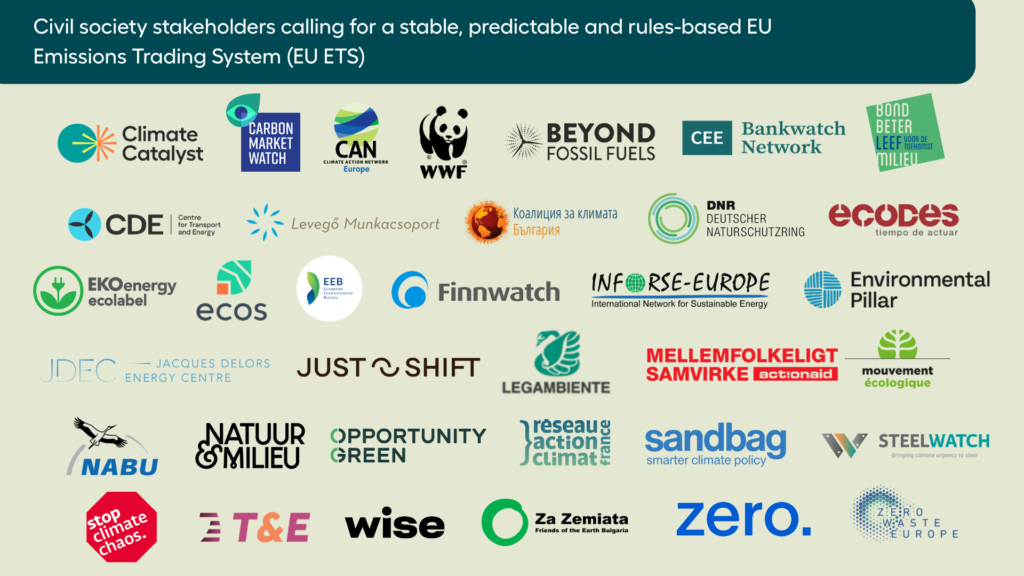
Ahead of the March European Council meeting, we’ve joined a group of 35 civil society organisations calling on EU leaders to protect the integrity of the EU Emissions Trading System.
ICC reform and expansion risks diverting ETS revenues from real climate action
Sandbag and 14 other organisations urge the European Commission to reform, not expand, the ETS Indirect Cost Compensation scheme — warning that current proposals risk diverting climate funding into untargeted fossil subsidies.