


The EU Emissions Trading System (ETS) has been facing growing political pressure from several Member States. We show that these claims are merely a smoke screen distracting from government inaction on real issues.
EU ETS under pressure
The EU Emissions Trading System (ETS) has been facing growing political pressure from several Member States. In a letter to European Commission President Ursula von der Leyen, Czech Prime Minister Andrej Babiš attributeddeclining industrial competitiveness to the direct cost of emissions allowances (EUAs) under the EU ETS, and to its indirect costs to electricity users through power prices.[1] The letter, made public on 13 April, had been sent on 2 April 2026, the day after the Commission proposed a reform of the Market Stability Reserve, the implementation of which would lead to a reduction of EUA prices, which in turn would risk damaging the integrity of the ETS.
In a similar manner in February, the Italian government had sounded the alarm over high electricity costs incurred by the country’s industry.[2] The Italian government subsequently passed a decree to reimburse the carbon costs paid by the country’s CCGT gas power plants, and — ahead of a European Council meeting on 19 March — called for the immediate suspension of the EU ETS pending a solution to these high costs.
This brief shows that these claims from Italy and Czechia are merely a smoke screen distracting from government inaction on real issues.
Direct ETS costs are a false culprit
Czechia’s Prime Minister Babiš claimed that the EU ETS negatively affects European industry competitiveness, blaming “the current price of ETS allowances” for the closure of industrial power plants and diminishing capacity. Babiš further stated that “over the past five years, the EU has recorded a decline in production capacity of at least 10% in the chemical and cement industries, and we can see a similar situation in steel and aluminium productionas well”.
However, in the past five years, companies in the cement and chemical industries, but also steel, aluminium and others, have received free emissions allowances specifically to cancel out the effect of carbon costs on competitiveness. The scale of this protection is substantial: free allowances cover nearly 100% of emissions on average across these sectors in the EU. Furthermore, an excess of free allowances has, in some cases, resulted in an effective negative carbon cost, meaning that some firms have profited from the scheme.
For example, in 2024, the European cement and lime industry received free allowances that covered 107.3 million tonnes of CO₂ compared to reported emissions of only 102.1 million tCO₂[3]. It is therefore difficult to argue that the current price of ETS allowances is to blame for declining European or Czech industrial competitiveness.
Under-used compensation
Mr. Babiš also blamed ETS costs indirectly borne by companies through power prices as responsible for EU industrial competitiveness woes, noting that ETS costs are responsible for “up to 24%” of power prices.
However, the Czech Prime Minister failed to mention that the EU ETS framework contains a mechanism designed to shield industrial electricity users from carbon-related costs. Under Indirect Cost Compensation (ICC) rules, EU Member States have been able to use ETS auction revenues to reimburse eligible industries for their carbon-related electricity costs. Up until 2025, the state aid rules limited the support to 75% of indirect carbon costs,[4] but this limit was based on overestimated emission factors.
For example, the CO₂ emission factor applicable for Italy was 0.46 tCO2/MWh (see Table 1), so 75% thereof amounted to 345kg CO₂ per MWh — which is comparable to most CCGT gas-fired power plants emissions. For Czechia, the applicable CO₂ emission factor was 0.85 tCO2/MWh, meaning the country’s support could be based on 638kg CO₂ per MWh – which is closer to coal power emissions, an activity not impacted by the current energy price spike. As a result, ICC rules allowed Member States to provide higher compensation than the actual costs borne by industry.
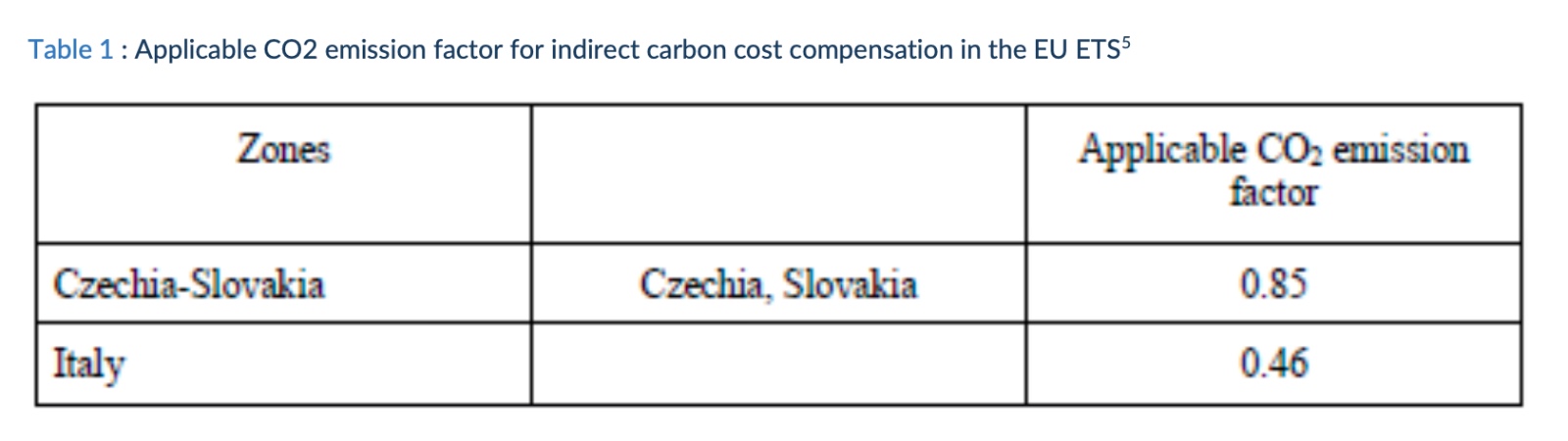
However, it becomes evident that both countries have only been making marginal use of ICC.
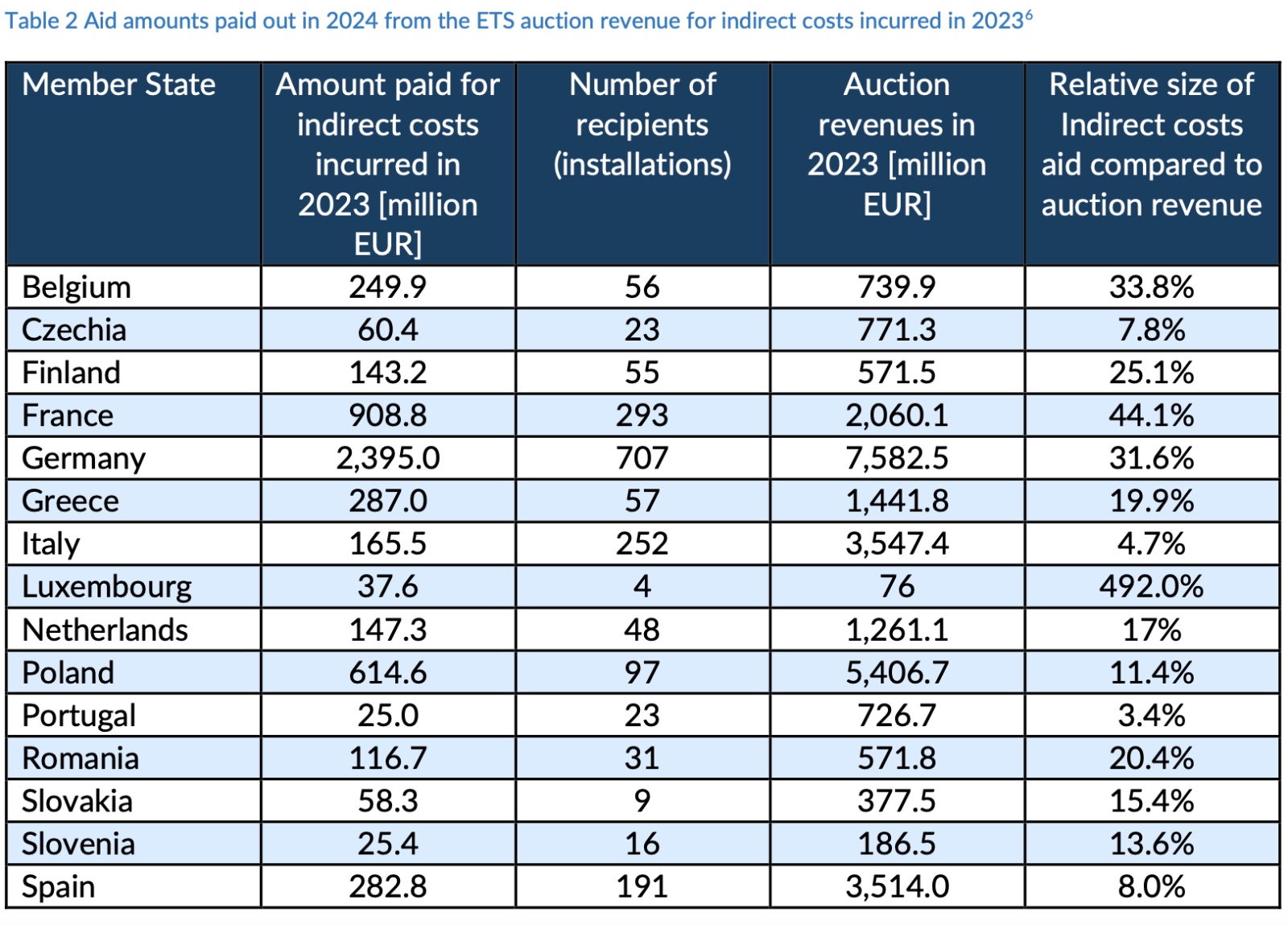
As shown by Table 2, Czechia’s ICC allocation in 2024 was only 7.8% (€60.4 million) of the country’s ETS revenues. Italy allocated even less than Czechia, at only 4.7% (€165.5 million) of its ETS revenues as ICC, despite earning more ETS auction revenues in 2023 than any other Member State that utilised ICC aid, with the exception of Germany and Poland. In comparison, Germany allocated 31.6% (€2.40bn), and France allocated 44.1% (€909m). As this comparison shows, the gap in ETS revenues allocated as ICC by Czechia and Italy is not one of capacity.
In fact, the Italian decree is strikingly similar to ICC, which is designed to shield industrial electricity users from their carbon costs. By replicating ICC, Italy’s decree demonstrates that, when used to their full potential, tools such as ICC are sufficient to address the effects of the ETS on industry competitiveness of energy-intensive sectors.
What the EU ETS does – and doesn’t
What ICC does not do – nor the Italian decree – is tackle the effects of non-ETS effects related to high gas prices, which the European Commission has addressed in its Middle East crisis Temporary State aid Framework (METSAF), published on 29 April 2026.[7]
The framework is a temporary change in State Aid rules in response to the war in Iran and its impact on gas prices and EU competitiveness, but not the EU ETS. As made clear by the text, aid instruments must “only compensate certain gas costs increases and do not cover the compliance costs of the [ETS] nor use ETS prices as a proxy to determine compensation, therefore maintaining the obligations and incentives of the ETS”. This Communication further notes that temporary support due to the current energy crisis “should not jeopardise efforts to transition towards using clean energy”.
It is important to distinguish what the EU ETS does and what it does not do. By providing generous amounts of free emissions allowances for direct costs and an even more generous compensation scheme for indirect costs, the ETS was designed to have, on average, a negligible effect on industry costs.
Both Czechia and Italy have spent more political energy arguing against the carbon market than on offering compensation for industrial power users for their carbon-related costs through the mechanism the ETS already provides. The ICC allocations by Czechia and Italy fall significantly short in comparison with the compensation allocated by Member States with comparable or even lower ETS revenues. This is evidence of both countries declining to use what the ETS offers, and not evidence of the ETS damaging EU industry competitiveness. By replicating ICC as national policy, Italy clearly demonstrates that the existing mechanisms under the ETS are sufficient and capable tools to address the concerns raised by both Czechia and Italy.
Suspension of the ETS or increasing the number of free EUAs is not only unnecessary, it would in fact undermine the EU’s ability to reduce fossil fuel dependency.
Notes
[1] Letter of the Czech Republic to the European Commission, 02.04.2026.
[2] Munster, B., Weise, Z., and Giordano, E. ‘Italy calls for suspension of carbon price in major attack on EU climate policy’ POLITICO, 26.02.2026.
[3] Source: EU Transaction Log
[4] The limit has since been raised to 80%.
[5] European Commission (2021), Annex III of Communication C(2021) 8413 final, supplementing the Guidelines on certain State aid measures in the context of the system for greenhouse gas emission allowance trading post-2021
[6] European Commission, ‘Report from the Commission of the European Parliament and the Council on the functioning of the European carbon market in 2024’ COM (2025) 735 final.
[7] Commission, ‘Communication from the Commission’ C(2026) 2947 final.
Related publications
March 11th 2026
August 21st 2025
July 8th 2025
More on the EU ETS

Webinar: Options for the EU ETS
We presented Sandbag’s analysis of different design options for the EU ETS, and discussed proposals to mitigate potential negative impacts.

EU ETS amendments: what matters
Our position paper analyses the proposals by the Commission and EU ETS rapporteur MEP Peter Liese and presents Sandbag’s proposals.

Putting a seat belt on allowance use: how aviation could do its part
This brief proposes that access by airlines to emission allowances from other sectors should gradually be reduced.

EU ETS review: impacts on the market balance
In this brief, we analyse how the proposed changes will impact the supply and demand balance of the emission allowance market.
Sandbag responds to Thyssenkrupp
Our technical brief on how the ETS is a net benefit for European steelmakers was covered by ESG.Table, alongside a response from Thyssenkrupp Steel, which raised three objections. This response analyses the German steelmaker’s claims.
EU steelmaking: the ETS money is coming!
This brief challenges recent industry claims that EU steelmakers are being harmed by the EU’s Emissions Trading System and finds that the opposite is true.

EU ETS Reform: Let’s not invalidate climate policy!
Based on our updated EU ETS simulator, this technical brief models the impact of the several proposals on the carbon market’s supply/demand balance under the European Commission’s impact assessment emission scenarios.
Improving EU ETS benchmarks: Response to the European Commission’s public consultation on EU ETS benchmarks
Sandbag’s response to the public consultation on the European Commission’s proposed revision of the benchmark values of free allocation of emission allowances (2026-2030).
Don’t Ruin the EU ETS! Joint NGO Letter to the European Council
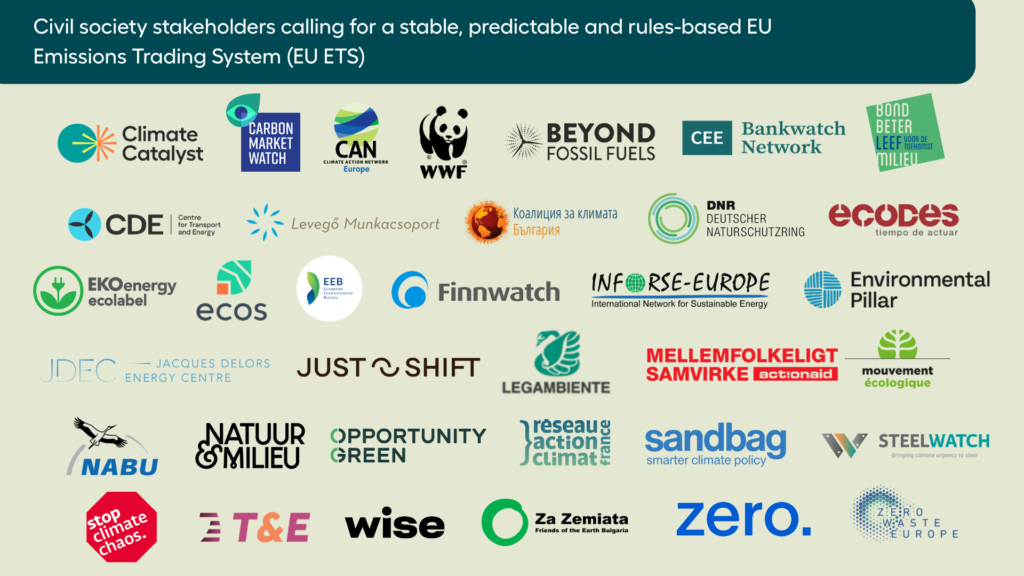
Ahead of the March European Council meeting, we’ve joined a group of 35 civil society organisations calling on EU leaders to protect the integrity of the EU Emissions Trading System.
ICC reform and expansion risks diverting ETS revenues from real climate action
Sandbag and 14 other organisations urge the European Commission to reform, not expand, the ETS Indirect Cost Compensation scheme — warning that current proposals risk diverting climate funding into untargeted fossil subsidies.