


Sandbag’s response to the public consultation on the European Commission’s proposed revision of the benchmark values of free allocation of emission allowances (2026-2030).
Windfall profits for steel but not for recycling
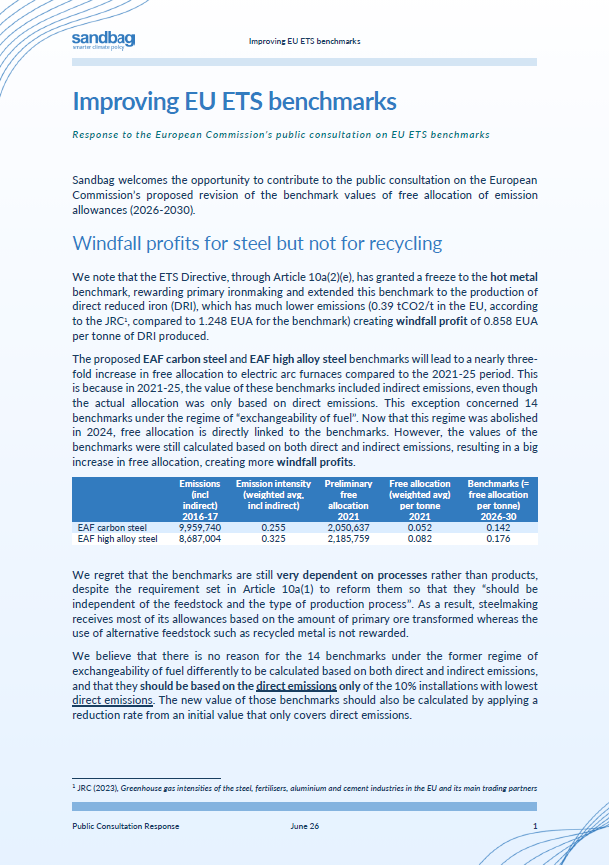
We note that the ETS Directive, through Article 10a(2)(e), has granted a freeze to the hot metal benchmark, rewarding primary ironmaking and extended this benchmark to the production of direct reduced iron (DRI), which has much lower emissions (0.39 tCO2/t in the EU, according to the JRC, compared to 1.248 EUA for the benchmark) creating windfall profits of 0.858 EUA per tonne of DRI produced.
The proposed EAF carbon steel and EAF high alloy steel benchmarks will lead to a nearly three-fold increase in free allocation to electric arc furnaces compared to the 2021-25 period. This is because in 2021-25, the value of these benchmarks included indirect emissions, even though the actual allocation was only based on direct emissions. This exception concerned 14 benchmarks under the regime of “exchangeability of fuel”. Now that this regime was abolished in 2024, free allocation is directly linked to the benchmarks. However, the values of the benchmarks were still calculated based on both direct and indirect emissions, resulting in a big increase in free allocation, creating more windfall profits.

We regret that the benchmarks are still very dependent on processes rather than products, despite the requirement set in Article 10a(1) to reform them so that they “should be independent of the feedstock and the type of production process”. As a result, steelmaking receives most of its allowances based on the amount of primary ore transformed whereas the use of alternative feedstock such as recycled metal is not rewarded.
We believe that there is no reason for the 14 benchmarks under the former regime of exchangeability of fuel differently to be calculated based on both direct and indirect emissions, and that they should be based on the direct emissions only of the 10% installations with lowest direct emissions. The new value of those benchmarks should also be calculated by applying a reduction rate from an initial value that only covers direct emissions.
Turn fallback sub-benchmarks into product benchmarks
The heat and fuel benchmarks (together called “fallback”) were calculated based on the assumption that biomass is emissions-free, which is why the 10% installations with the lowest emissions have driven down these benchmarks to low values. This should be changed: biomass is not zero-emission and its use is unsustainable on a large scale. Thus, emissions from biomass use should be accounted for in ETS yearly reporting.
However, we don’t think the fallback benchmarks should simply be adjusted upwards as a result. Instead, the opportunity should be seized to create new product benchmarks that are independent of production processes, as commanded by Article 10a(1). In this sense, we welcome the Commission’s initiative to cover some of the installation currently using fallback benchmarks under a new set of benchmarks.
However, the proposed benchmarks and their calculation method are both disappointing. To be independent of production processes, they should be set per volume of goods produced (e.g. per tonne of sugar, refractory ceramics etc.). Instead, the Commission proposes fallback sub-benchmarks which will keep awarding free allocation based on the amount of energy (heat or fuel) consumed, encouraging waste and discouraging efficiency, circularity and alternative processes.
It is possible to replace fallback sub-benchmarks with actual product benchmarks. All this would require is to collect 2021-22 production data for the products considered and calculate benchmark values based on the 10% lowest emission plants producing those goods over 2021-22. To avoid litigation risk on grounds of preferential treatment, a reduction rate could be applied equal to 6 times the average annual reduction rate of all benchmarks, due to the 6 years between 2022 (date of the collected data) and 28 (middle of the 2026-30 period), like for (most) other benchmarks.
Although this method would differ from using a 2007-8 base year with floored and capped reduction rates, the methodological difference would be very minor: it would give the same results if the 10% lowest emission plants have reduced their emission intensity by amounts withing the current cap and floor (0.3%-2.5% annually) since 2007, i.e. more than 6% or less than 50%, which is the case for most other products.
Methodological differences between benchmarks are not a new idea. The regime of exchangeability of fuel is an example of differentiated methodologies across benchmarks, and there are many more, such as the process emissions benchmark which follows yet another very different one. And the Commission’s own proposal to create fallback sub-benchmarks covering only part of the installations currently covered by the fallback benchmarks would also create a separate regime.
So we do not see a greater risk of challenge in applying product benchmarks instead of fallback sub-benchmarks. Rather than creating windfall profits, we should seize this opportunity to – at last – create incentives for sustainable practices as required by the ETS Directive.
Related publications
November 13th 2025
More on the EU ETS

Webinar: Options for the EU ETS
We presented Sandbag’s analysis of different design options for the EU ETS, and discussed proposals to mitigate potential negative impacts.

EU ETS amendments: what matters
Our position paper analyses the proposals by the Commission and EU ETS rapporteur MEP Peter Liese and presents Sandbag’s proposals.

Putting a seat belt on allowance use: how aviation could do its part
This brief proposes that access by airlines to emission allowances from other sectors should gradually be reduced.

EU ETS review: impacts on the market balance
In this brief, we analyse how the proposed changes will impact the supply and demand balance of the emission allowance market.
Sandbag responds to Thyssenkrupp
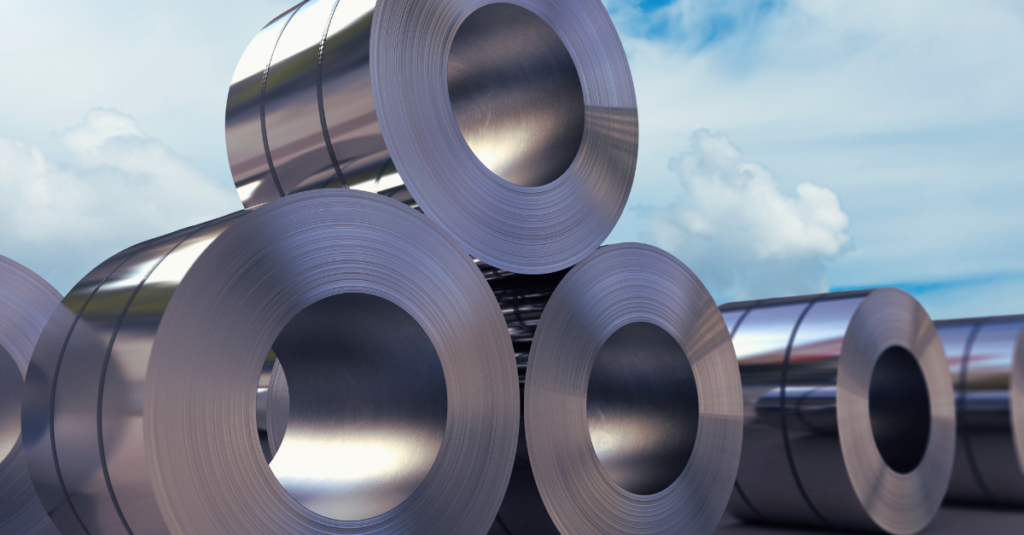
Our technical brief on how the ETS is a net benefit for European steelmakers was covered by ESG.Table, alongside a response from Thyssenkrupp Steel, which raised three objections. This response analyses the German steelmaker’s claims.
EU steelmaking: the ETS money is coming!
This brief challenges recent industry claims that EU steelmakers are being harmed by the EU’s Emissions Trading System and finds that the opposite is true.

EU ETS Reform: Let’s not invalidate climate policy!
Based on our updated EU ETS simulator, this technical brief models the impact of the several proposals on the carbon market’s supply/demand balance under the European Commission’s impact assessment emission scenarios.
Rhetoric vs reality: setting the record straight on the impact of the EU ETS on industrial competitiveness
This brief examines whether the claims by Czechia and Italy that the EU ETS is responsible for declining industrial competitiveness hold up to scrutiny.
Don’t Ruin the EU ETS! Joint NGO Letter to the European Council
Ahead of the March European Council meeting, we’ve joined a group of 35 civil society organisations calling on EU leaders to protect the integrity of the EU Emissions Trading System.
ICC reform and expansion risks diverting ETS revenues from real climate action
Sandbag and 14 other organisations urge the European Commission to reform, not expand, the ETS Indirect Cost Compensation scheme — warning that current proposals risk diverting climate funding into untargeted fossil subsidies.