

Our technical brief on how the ETS is a net benefit for European steelmakers was covered by ESG.Table, alongside a response from Thyssenkrupp Steel, which raised three objections. This response analyses the German steelmaker’s claims.
On 7 July, Sandbag published a brief called EU Steelmaking: the ETS money is coming! Our brief challenged recent industry claims that EU steelmakers are being harmed by the EU’s Emissions Trading System and found that the opposite is true. The brief warned against slowing down the phase-out of free allocation, because EU steelmakers will likely benefit from the EU’s carbon market and its Carbon Border Adjustment Mechanism despite the scheduled phase-out, and any extra free allowances would be costly to EU taxpayers.
Our brief was covered by ESG.Table, alongside a response from Thyssenkrupp Steel, which raised three objections. This response analyses the German steelmaker’s claims.
Will steelmakers still benefit after 2030?
Our brief argued that, until 2030, the free allocation regime is very generous, leading to windfall profits and that the CBAM will allow steelmakers to recoup their ETS costs by passing them through to their customers. This price effect will be amplified in the first few years of the CBAM, allowing European producers to recoup their cost several times over.
Thyssenkrupp noted that: “The real challenge for the European steel industry, however, will not arise until 2030, when free allocations will decrease, while at the same time, low-emission production facilities are expected to set and tighten the ETS benchmarks” (emphasis added).
We understand that Thyssenkrupp refers to the period after 2030, given that the ETS benchmarks are set until that date. Our view is that the underlying dynamic of EU steelmakers passing carbon costs through to customers while imports face proportionally higher CBAM costs does not disappear after 2030, even as free allocation declines further. Considering that in the early years of the CBAM’s implementation, importers are relatively penalised by the and high default values, EU producers will benefit from a competitive advantage. Beyond 2030, margins will likely normalise compared to the windfall period we identified for 2026-2028.
In the long run, the conditions boosting windfall profits will likely wear out, but if the CBAM properly prevents carbon leakage (which is its purpose), it should still enable EU producers to raise their prices and match costs with revenues. We don’t know all the parameters for that period yet, but the Commission’s mandate to prevent carbon leakage is a better guarantee than extended free allocation.
Did we account for non-EU export markets and CBAM coverage gaps?
Thyssenkrupp noted that our brief did not address the competitive conditions for exports to non-European countries, as well as imported products with a high steel content that are not yet covered by the CBAM. The company argued that the CBAM does not protect businesses that export goods outside the EU (which will have to pay for an increasing share of their emissions), nor does it cover imported products with a high steel content.
Our brief focused on the competitive environment of the EU market and didn’t model export dynamics to countries outside the EU, or the CBAM’s current coverage gaps. Both are worth examining in detail and we support closing legitimate gaps in the CBAM’s scope.
The first point, concerning export competitiveness, is only valid as long as the ongoing legislative process to create a compensation mechanism for exports is not completed. While EU manufacturers can pass through their carbon costs to customers in the EU, they cannot do the same for customers outside the EU. In December 2025, the Commission submitted a legislative proposal for a Temporary Decarbonisation Fund covering 2026-2027, intended to address this gap ahead of a longer-term mechanism. The Council and Parliament will likely strengthen this further to better compensate exporters.
The second point concerns goods that are down the value chain of CBAM-covered goods. EU manufacturers of CBAM-covered goods can raise their prices for EU customers. However, manufacturers will face higher costs without increasing their own selling prices, unless their own downstream goods are covered by the CBAM as well. In December 2025, the Commission proposed to add 180 downstream products to the CBAM’s initial coverage, partly based on a “price push” criterion which reflects the proportion of ETS costs to the value of the products. The Parliament and Council proposed to extend this list even further, which will likely ensure a high rate of cost pass-through for all goods with any significant embedded ETS costs.
Both mechanisms are still moving through the legislative process, and we support their continued development to close these gaps.
Our brief did not model export dynamics to countries outside the EU, or the CBAM’s current coverage gaps. Both gaps identified by Thyssenkrupp are already being addressed by mechanisms in the EU legislative pipeline.
Can ETS gains alone finance the transition to green steel?
Our brief indicated that, for a manufacturer of steel using hydrogen DRI, the net revenues from free allocation minus emissions could reach 25% of the value of steel hot-rolled coils, at today’s market price.
Thyssenkrupp did not dispute this figure but pointed out that these amounts do not make up for the “billions in investments, competitive energy prices, hydrogen availability and customer markets” needed to develop hydrogen steel manufacturing at scale.
We agree. The CBAM and ETS are a source of financing for the green transition. Whether that financing is sufficient on its own is a separate question, one we did not set out to model in our original brief. Increased revenues generated by the combined ETS and CBAM will create a sustainable business case for green steel if allowance prices are high enough and the CBAM prevents carbon leakage. These two conditions require an ambitious ETS cap and effective anti-circumvention measures. We also noted that a growing amount of revenues from the sale of allowances will complement these in the coming years. In contrast, prolonged free allocation for CBAM sectors would slow down the decrease of the cap and reduce the carbon price.
But whether or not these revenues are sufficient is a separate question from the one our brief addressed: whether the ETS is a net benefit or a net cost for steelmakers, and our brief found that the ETS is a net benefit for European steelmakers.
Related publications
July 7th 2026
More on the EU ETS and steel

Webinar: Options for the EU ETS
We presented Sandbag’s analysis of different design options for the EU ETS, and discussed proposals to mitigate potential negative impacts.

EU ETS amendments: what matters
Our position paper analyses the proposals by the Commission and EU ETS rapporteur MEP Peter Liese and presents Sandbag’s proposals.
Putting a seat belt on allowance use: how aviation could do its part
This brief proposes that access by airlines to emission allowances from other sectors should gradually be reduced.
EU ETS review: impacts on the market balance
In this brief, we analyse how the proposed changes will impact the supply and demand balance of the emission allowance market.
EU steelmaking: the ETS money is coming!
This brief challenges recent industry claims that EU steelmakers are being harmed by the EU’s Emissions Trading System and finds that the opposite is true.

EU ETS Reform: Let’s not invalidate climate policy!
Based on our updated EU ETS simulator, this technical brief models the impact of the several proposals on the carbon market’s supply/demand balance under the European Commission’s impact assessment emission scenarios.
Improving EU ETS benchmarks: Response to the European Commission’s public consultation on EU ETS benchmarks
Sandbag’s response to the public consultation on the European Commission’s proposed revision of the benchmark values of free allocation of emission allowances (2026-2030).
Rhetoric vs reality: setting the record straight on the impact of the EU ETS on industrial competitiveness
This brief examines whether the claims by Czechia and Italy that the EU ETS is responsible for declining industrial competitiveness hold up to scrutiny.
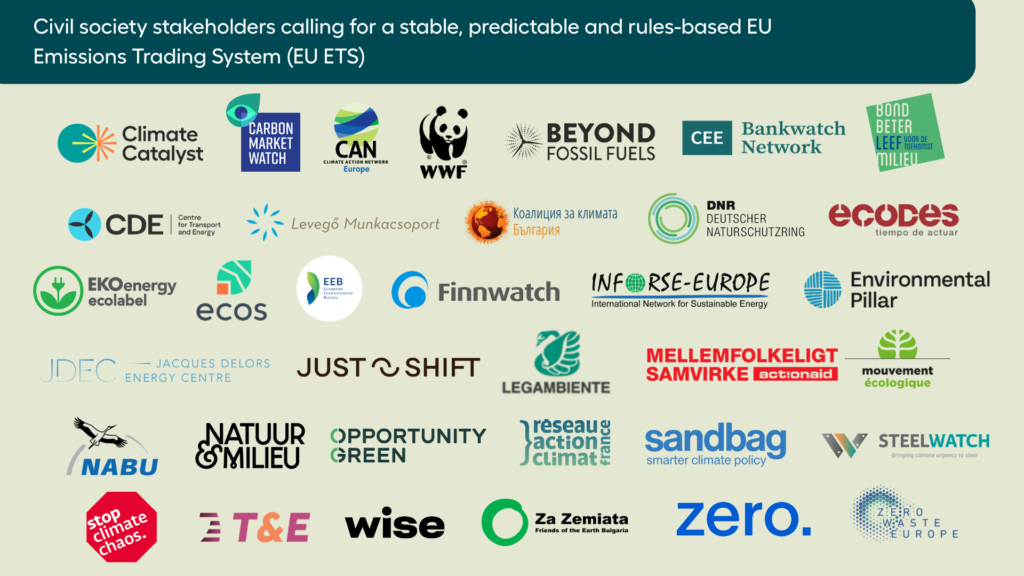
Don’t Ruin the EU ETS! Joint NGO Letter to the European Council
Ahead of the March European Council meeting, we’ve joined a group of 35 civil society organisations calling on EU leaders to protect the integrity of the EU Emissions Trading System.
Steel labelling: Beyond the sliding scale
As EU policymakers debate how to certify low-carbon steel, Sandbag’s new briefing analyses the “sliding scale” method — and outlines why it may hinder rather than help decarbonisation. A new model is proposed based on product-specific benchmarks, multi-tier ratings, and circularity incentives.