

EU ETS Simulator
With our EU ETS Simulator, you can analyse the impact of changing assumptions on the EU Emissions Trading System (ETS).
You can adjust assumptions and analyse how they affect the supply and demand balance of the EU ETS.
This simulator uses data from the European Commission up to 2025 and 3 emissions scenarios from the Commission’s impact assessment on EU climate law from 2024.
Select and combine different scenarios on the menu on the left by clicking the buttons.
Last updated: October 1, 2026
Tutorials
The EU ETS’ current design
MSR Invalidation
Restrict aviation access to EUAs
Q&A
What do the default positions of all the options represent?
They represent the ETS’ current design, except for the emissions scenarios (top buttons).
Why are some of the buttons light blue?
The light blue buttons represent design features proposed by the European Commission on 17 July 2026 in the directive proposal COM(2026) 616, which has not been adopted yet.
What are the emissions scenarios?
The emissions scenarios are derived from the European Commission’s impact assessment (IA) published in February 2024. The forecasts used for the EU ETS scope are the IA’s figures for “industry”, “energy supply”, “intra-EU aviation”, “intra-EU navigation” and “50% extra-EU maritime MRV”.
- S1: 75% reduction in EU-wide emissions by 2040 (ETS sectors: -83%)
- S2: 85% reduction in EU-wide emissions by 2040 (ETS sectors: -89%)
- S3: 95% reduction in EU-wide emissions by 2040 (ETS sectors: -93%)
What are the two Cap options?
In the “current” option, the linear reduction factor (LRF) is set to 4.4% during 2031-40.
In the “COM proposal” option, LRF is set at 3.7% from 2031-35, then at 1.7% thereafter.
What does “transfer CBAM to non CBAM” mean?
Currently, the allowances that are not allocated for free because of the CBAM are auctioned to finance the Innovation Fund. With this option, they would instead be allocated to non-CBAM sectors first, to keep the CSCF at 1, if possible. In addition, the remaining ones would be auctioned off, to finance the Innovation Fund.
What does the “COM: 260m to buy removals” option do?
If selected, this option adds 260 million EUAs equally distributed over 2031-40 to raise funds for the Commission to purchase removals, pursuant to the proposed Article 9c of the ETS Directive.
What do the “Invalidate MSR allowances” buttons do?
When “Yes” is selected, MSR allowances are invalidated following current rules.
When “No” is selected, MSR allowances stop being invalidated from 2027 onwards, pursuant to the amendment proposal COM(2026) 153 published by the Commission on 1 April 2026.
What are the “MSR method” options?
When set at “Current”, the MSR thresholds and TNAC calculation are as set currently.
When “COM” is selected, MSR thresholds and release rates decline by 4% per year from 2029 onwards and the intake rate switches from 24% to 12% in 2027 as per the Commission’s proposed amendment to Articles 1(5) and 1(6) of the MSR Decision, and TNAC calculations include aviation demand from 2024 onwards, as per the amendment to Article 1(4a).
What products or sectors does the CBAM extension cover?
This covers organic chemicals, polymers, and refinery products.
What is the option to limit aviation access to EUAs about?
The option “Yes” assumes that the demand for EUAs from airlines declines linearly from its 2030 level linearly to zero in 2040.
This would happen if, for example, a different type of allowances were issued to airlines (like EUAAs before 2025) and airlines could meet their compliance using those allowances plus a limited percentage of EUAs.
Such a limitation would make EUAAs more valuable and allow Member States to raise more funds, for example to develop rail transport infrastructure.
An important feature of the EU ETS is its imbalance between the aviation sector (which has consistently emitted more than its cap) and the stationary sectors (which have emitted less than their cap) while sharing the same emission allowances. This situation procures aviation with a relatively cheap compliance instrument, as buying surplus stationary allowances is much cheaper than curbing aviation emissions. In contrast, for the other sectors, this creates more demand and pushes up prices. The sector’s current unlimited access acts like an abatement deterrent, making decarbonisation the least economical option. By purchasing emission allowances from stationary installations, airlines effectively shift the decarbonisation burden onto other industry sectors.
What is the option to unfreeze hot metal?
Under Article 10a(2)(e) of the EU ETS Directive, which was introduced in an amendment in 2023, the “hot metal” free allocation benchmark is shielded from any reduction that would result from the extension of this benchmark to (less emission-intensive) DRI production. Without this article, the benchmark’s value (based on the 10% lowest emission plants) would take into account DRI production plants, which would make it much lower.
What is the difference between the “high” and “low” benchmarks options?
With the low benchmark option, all benchmarks decrease at the maximum rate possible of 2.5% per year.
With the high benchmarks option, benchmarks decline at their historical rate, except for a few benchmarks (hot metal, grey clinker, …) which were extended and will include low-emission plants in future updates.
What do the “Full CBAM year” buttons do?
If set to 2034, the CBAM factor follows its current schedule, with free allocation fully phased out by 2034 for CBAM sectors.
If set to 2038, the CBAM factor follows the schedule proposed by the Commission, reaching the full phase out of free allocation only in 2038, as per the proposed amendment to Article 10a(1a) of the ETS Directive.
Did you take into account extensions of the EU ETS to international flights or incinerators?
No, because any extension would increase both the emissions coverage and the cap. The overall impact on the market balance remains uncertain, and any calculation at this stage would rely too heavily on assumptions to be meaningful.
Where does the data come from?
Historical emissions, free allocation, and auction data come from the EU Transaction Log and auctioning platforms.
Short-term production outlooks come from established sector associations (Eurofer, Cement Europe etc.).
Long-term projections are derived from the scenarios in the Commission’s 2024 Impact Assessment for EU Climate Law.
What has changed since the previous version?
- 17 July 2026: New parameters were implemented to reflect the Commission’s proposal on 17 July 2026 (alongside Sandbag’s own proposals), including a free allocation buffer of 4% (instead of 3%) over 2031-40, increased free allocation in 2027-30 for plants covered by fallback benchmarks as per the amendment proposal COM(2026) 619 to the ETS Directive, and new metrics are now displayed, such as the cross-sectoral correction factor (CSCF).
- 22 September 2026: Update of the CDR allocation to 250 million EUAs, distributed through a linear increase between 2031 and 2040.
- 22 September 2026: Incorporation of the new cap proposed by Peter Liese on 10 September 2026.
- 22 September 2026: Transfer of 200 millions allowances from the new entrants’ reserve to the market stability reserve.
- 22 September 2026: Addition of options corresponding to the extension propose by the Commission:
- Aviation: extending the scope of the aviation ETS to cover all flights departing from an airport situated in the EEA and landing in aerodromes in third countries located no more than 5,000 kilometres from the aerodrome of Frankfurt, from 2029 to 2032.
- Shipping: extending the scope of the maritime ETS to specific categories of small vessels (with a gross tonnage below 5 000 but not below 400) from 2031, based on the MRV of 2023 data.
- Waste: extending the ETS to municipal waste incineration from 2031.
- 1 october 2026: Change the LRF of aviation and maritime & Add the option 800m invalidation treshold
Related publications

Putting a seat belt on allowance use: how aviation could do its part
This brief proposes that access by airlines to emission allowances from other sectors should gradually be reduced.
EU ETS review: impacts on the market balance
In this brief, we analyse how the proposed changes will impact the supply and demand balance of the emission allowance market.

EU ETS Reform: Let’s not invalidate climate policy!
Based on our updated EU ETS simulator, this technical brief models the impact of the several proposals on the carbon market’s supply/demand balance under the European Commission’s impact assessment emission scenarios.

Simulating CDR in the EU ETS: The Risks of Premature Integration
Sandbag has developed an ‘ETS + CDR simulator’ to help visualise and explore the impact that CDR integration could have on the ETS, assess the demand it could create for CDR, and highlight the potential consequences of this demand. This report uses the simulator to explore how different integration pathways could affect emissions reductions, carbon prices, and potentially lead to negative externalities.
Supply and demand in the EU ETS: It’s the hydrogen, stupid!
Learn about the supply and demand balance of the EU ETS through the end of its fourth phase in 2030, based on the latest market data and policy parameters. Are the results aligned with the EU’s target of a 55% reduction in emissions?
More on the EU ETS

Webinar: Options for the EU ETS
We presented Sandbag’s analysis of different design options for the EU ETS, and discussed proposals to mitigate potential negative impacts.

EU ETS amendments: what matters
Our position paper analyses the proposals by the Commission and EU ETS rapporteur MEP Peter Liese and presents Sandbag’s proposals.
Putting a seat belt on allowance use: how aviation could do its part
This brief proposes that access by airlines to emission allowances from other sectors should gradually be reduced.
EU ETS review: impacts on the market balance
In this brief, we analyse how the proposed changes will impact the supply and demand balance of the emission allowance market.
Sandbag responds to Thyssenkrupp
Our technical brief on how the ETS is a net benefit for European steelmakers was covered by ESG.Table, alongside a response from Thyssenkrupp Steel, which raised three objections. This response analyses the German steelmaker’s claims.
EU steelmaking: the ETS money is coming!
This brief challenges recent industry claims that EU steelmakers are being harmed by the EU’s Emissions Trading System and finds that the opposite is true.
EU ETS Reform: Let’s not invalidate climate policy!
Based on our updated EU ETS simulator, this technical brief models the impact of the several proposals on the carbon market’s supply/demand balance under the European Commission’s impact assessment emission scenarios.
Improving EU ETS benchmarks: Response to the European Commission’s public consultation on EU ETS benchmarks
Sandbag’s response to the public consultation on the European Commission’s proposed revision of the benchmark values of free allocation of emission allowances (2026-2030).
Rhetoric vs reality: setting the record straight on the impact of the EU ETS on industrial competitiveness
This brief examines whether the claims by Czechia and Italy that the EU ETS is responsible for declining industrial competitiveness hold up to scrutiny.
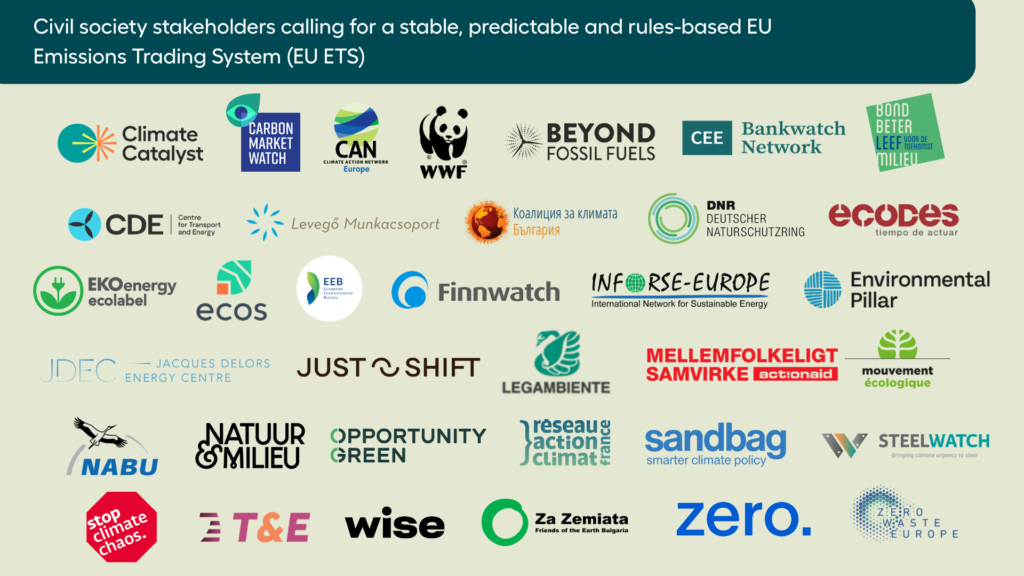
Don’t Ruin the EU ETS! Joint NGO Letter to the European Council
Ahead of the March European Council meeting, we’ve joined a group of 35 civil society organisations calling on EU leaders to protect the integrity of the EU Emissions Trading System.

Mundo Matogné. Rue d’Edimbourg 26, Ixelles 1050 Belgium. Sandbag is a not-for-profit (ASBL) organisation registered in Belgium under the number 0707.935.890. EU transparancy register no. 277895137794-73. VAT: BE0707935890