


Hydrogen is seen as central to the green transition, but overreliance on ‘green’ hydrogen could hinder Europe’s climate goals by diverting renewable energy from grid decarbonisation. What are the risks of high Renewable Fuels of Non-Biological Origin (RNFBO) deployment, and how could it impact the EU’s decarbonisation strategy?
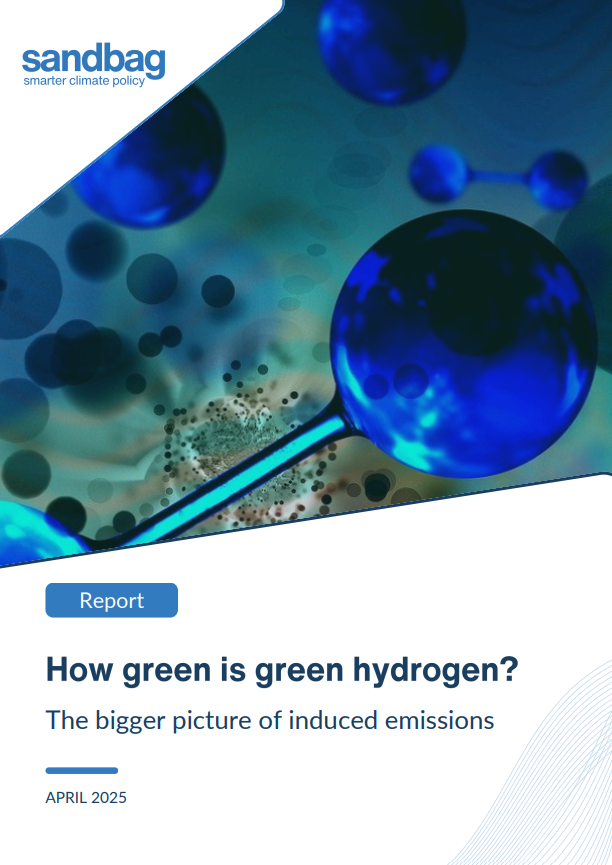
About the report
The EU’s amended Renewable Energy Directive (RED III) targets an increase in the share of renewables from 24.5% in 2023 to 42.5% by 2030, with ambitious sectoral sub-targets for RFNBO use in industry and transport. However, without stringent regulation, RFNBO deployment could cause emissions to flatline rather than decrease.
The report models different scenarios to assess the impact of hydrogen production on the electricity grid, quantifying ‘induced’ emissions associated with RNFBO production and comparing RFNBO use with alternatives like direct electrification or the displacement of fossil fuel-based electricity in the grid.
It shows that while producing hydrogen with a low carbon footprint is possible, when induced emissions are counted, the carbon footprint of RFNBOs can be very high.
Key findings
Hydrogen production can increase emissions
RFNBO production could generate more emissions than fossil-based hydrogen as it tends to divert renewables from decarbonising the grid.
In a highly interconnected EU grid, these ‘induced’ emissions could be even higher.
Direct electrification is more efficient
Electrifiying sectors such as transport is much more energy-efficient than relying on RFNBOs and should be prioritised where possible.
Hydrogen should be used strategically
RFNBOs should be prioritised for industries that already depend on fossil-fuel hydrogen, like ammonia and methanol production.
Policy adjustments are needed
Revise RED sub-targets to encourage energy-efficient solutions such as electrification more than hydrogen use.
Better emissions accounting in the RFNBO standard, to account for induced emissions.
Revised RFNBO standard to only make eligible hydrogen produced without induced emissions.
Related publications
Untangling the knots – Clearing the way to fast green hydrogen deployment
As the EU and some of its Member States are piling up subsidy schemes to try and kickstart a...
European Parliament clings to false solutions in Hydrogen Strategy vote
Committee MEPs are set to approve a report laden with risks to the EU's renewable energy...

Benchmarks and Free Allocation: Details reveal problems in the EU ETS
Sandbag is actively campaigning for changes to the EU ETS benchmarking system and an end to free...

Mundo Matogné. Rue d’Edimbourg 26, Ixelles 1050 Belgium. Sandbag is a not-for-profit (ASBL) organisation registered in Belgium under the number 0707.935.890. EU transparancy register no. 277895137794-73. VAT: BE277895137794-73