


Environmental organisations, think tanks and recycling industry call for measures to boost the use of recycled steel in the automotive sector
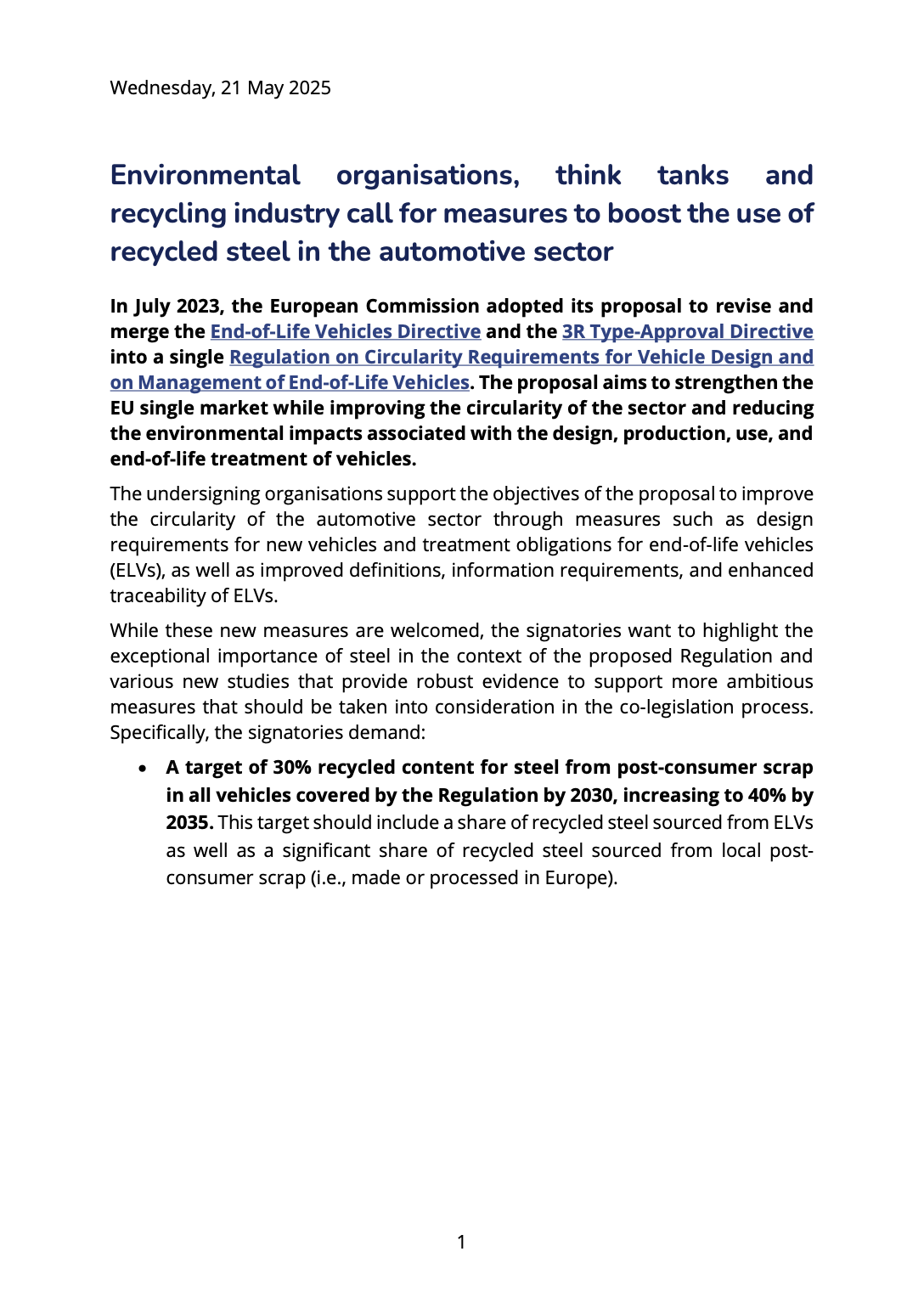
Sandbag co-signed a joint statement alongside leading environmental NGOs, think tanks, and recycling industry groups urging the EU to introduce binding targets for recycled steel scrap content in vehicles under the proposed Regulation on Circularity Requirements for Vehicle Design and on Management of End-of-Life Vehicles.
The statement highlights the underuse of recycled steel scrap in car manufacturing, despite its significant climate and resource benefits. Steel makes up 16% to 30% of cars’ embedded emissions from the production phase, yet only 6% of steel from end-of-life vehicles (ELVs) is reused for production of new vehicles. Clear targets would ensure that this regulation delivers on its potential to reduce industrial emissions and increases the circularity of the automotive sector.
The signatories call for minimum targets of 30% recycled content by 2030, rising to 40% by 2035, with a focus on steel sourced from ELVs and post-consumer scrap processed in Europe. These measures would reduce emissions, reduce reliance on raw materials like coking coal and iron ore, and keep valuable secondary materials within the EU economy.
Photo by nashvilledino2 from Canva
May 2025
Related Publications
July 14th 2025
More on the circular economy
Sandbag responds to Thyssenkrupp
Our technical brief on how the ETS is a net benefit for European steelmakers was covered by ESG.Table, alongside a response from Thyssenkrupp Steel, which raised three objections. This response analyses the German steelmaker’s claims.
EU steelmaking: the ETS money is coming!
This brief challenges recent industry claims that EU steelmakers are being harmed by the EU’s Emissions Trading System and finds that the opposite is true.
Steel labelling: Beyond the sliding scale
As EU policymakers debate how to certify low-carbon steel, Sandbag’s new briefing analyses the “sliding scale” method — and outlines why it may hinder rather than help decarbonisation. A new model is proposed based on product-specific benchmarks, multi-tier ratings, and circularity incentives.
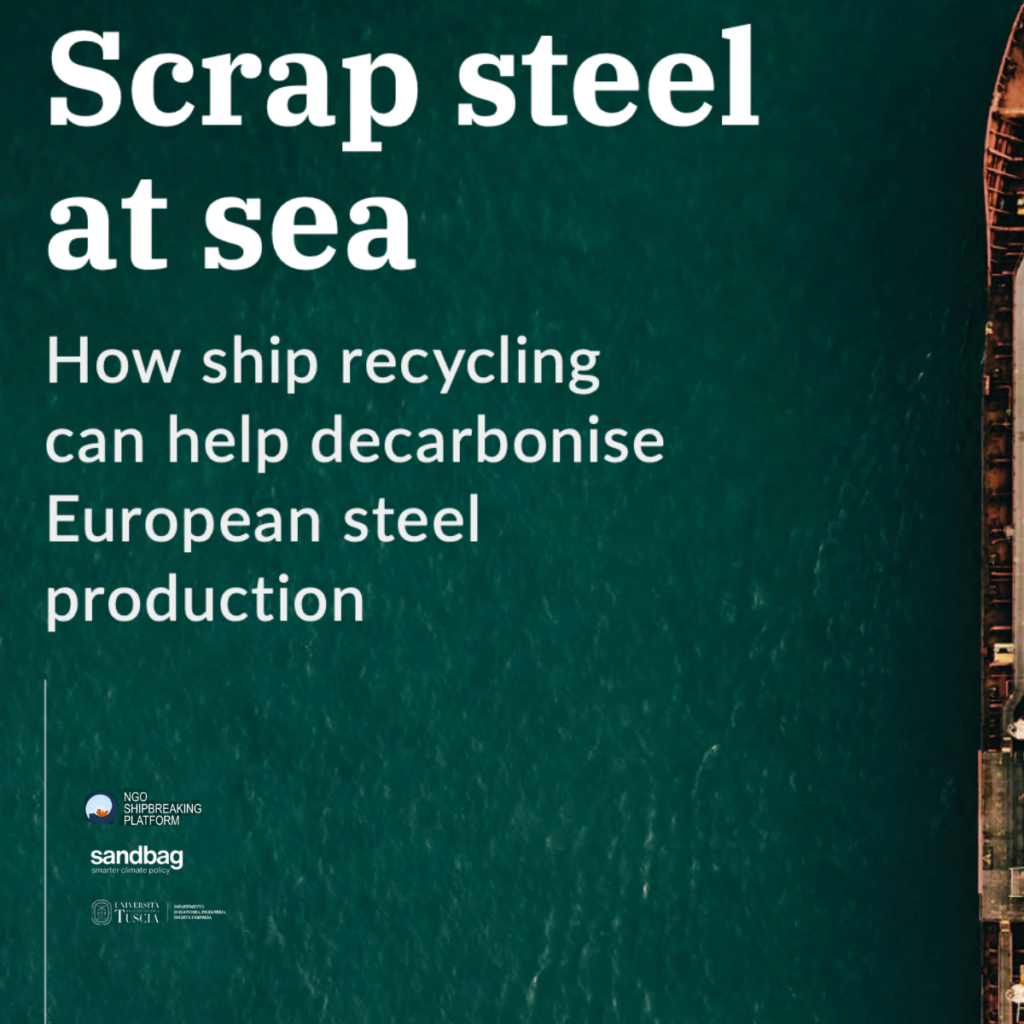
Scrap Steel at Sea: How ship recycling can help decarbonise European steel production
As Europe seeks to decarbonise its steel industry, a new Sandbag report highlights an overlooked solution: high-quality scrap steel from retired ships. With up to 15 million tonnes of certified scrap available annually, ship recycling could meet 20% of EU steel scrap demand — if policy gaps are addressed.
Sandbag’s feedback to the call for evidence on the Circular Economy Act
Sandbag welcomes the Circular Economy Act (CEA) as an important step to accelerate the transition to a circular economy in the EU. Progress in this area has been slow and this act is sorely needed to address systemic issues holding back circularity, including the current fragmented approaches across Member States.
New Principles for Steel Labelling: response to the consultation on the Industrial Decarbonisation Accelerator Act
Sandbag’s response to the EU’s Industrial Decarbonisation Accelerator Act sets out four principles to guide green steel labelling schemes, promoting credible standards based on lifecycle emissions and system-wide decarbonisation.
Steel emissions standards under threat from flawed “mass balance” proposal
A joint letter from 30+ NGOs warns that coal-based steel could be falsely labelled as green under proposed “mass balance” rules. The signatories call for traceable, credible emissions data in steel standards.

Towards a minimum recycled steel content in passenger cars: setting an initial target
The EU has around 286 million motor vehicles, and every year, 6.5 million of these are scrapped. If the steel scrap from these end-of-life vehicles (ELVs) is not managed well, valuable resources are lost, harming the environment.
Metallurgical flexibility: Enabling the aluminium and steel sectors for demand response
Electrification and flexibility are critical to decarbonising both industrial and electricity systems. But what happens when we combine the two? Industrial flexibility will play an increasingly important role as industry moves towards electrification.
A closer look at 2023 emissions: steelmaking caused a quarter of industry pollution
This brief analyses 2023 emissions under the EU Emissions Trading System (EU ETS), using the latest data available from the EU Transaction Log (EUTL) . It particularly focuses on the iron and steel sector.