
This technical brief explores the potential role of carbon capture, storage and utilisation (CCS/U) for Europe’s chemicals sector.
We find that CCS/U will be necessary in Europe’s chemicals sector, but only to a limited extent in targeted applications.
About the technical brief
Europe’s chemicals sector must reduce greenhouse gas emissions from its production processes, transition away from fossil feedstocks, and address the growing climate impact of its downstream products at the end-of-life stage. Within this context, the sector has positioned itself as “the carbon managers”, emphasising carbon capture, storage and utilisation (CCS/U) as central solutions for the sector.
This technical brief assesses how far that claim holds up under a full lifecycle and system-wide analysis. We find that while CCS/U will likely find some deployment in Europe’s chemicals sector, fundamental techno-economic constraints mean the overall emissions savings from these technologies are expected to be limited, in the context of the sector’s current footprint. CCS/U must be considered as one option for installations carrying out specific processes to reduce their emissions rather than a general decarbonisation strategy for the sector.
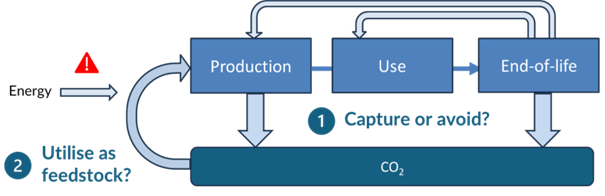
To what extent is carbon capture needed to reduce emissions from the sector, considering alternative abatement measures?
For chemicals production, around two thirds of emissions stem from fuel combustion for heat generation. Carbon capture may play a role as a transitional solution, most notably where processes produce concentrated CO₂ streams, such as in hydrogen and ammonia production, and where facilities are located close to CO₂ transport and storage infrastructure. For diffuse, low-concentration flue gases, however, capture costs are likely to be prohibitively high. In key processes such as steam cracking, electrification offers the most robust, future-proof pathway to deep decarbonisation and efforts should be focused on accelerating their deployment.
Modelling estimates, based on conservative electrification assumptions, foresee 35 Mt captured in 2050 (less than 8% of the total amount projected to be captured in the EU and just 9% of current lifecycle emissions of the sector) and just 5 Mt utilised for chemicals production (of which only 1 Mt is expected to come from the chemical industry).
The majority of lifecycle emissions from chemical products arise downstream, particularly from plastics at the end-of life stage. Addressing these emissions requires a shift toward greater circularity, but not all circular solutions deliver equivalent climate benefits. Demand reduction, reuse, repair and design-for-recycling are the cheapest and most energy-efficient ways to reduce emissions and policies to incentivise these practices should be enacted as a first priority. Even under optimistic assumptions, recycling yields mean that substantial volumes of virgin polymer production will remain unavoidable, reinforcing the importance of waste prevention. Mechanical recycling should, however, still be maximised due to the low cost and energy requirements of this process. Some thermal decomposition and waste incineration facilities equipped with carbon capture will be necessary, but these should be treated as last resort options rather than cornerstones of circularity in the sector.
Will carbon capture and utilisation (CCU) for chemicals production be feasible at scale?
Technology costs and efficiencies may evolve, but current evidence suggests that CCU will be a niche complement, rather than a pillar of decarbonisation. While the idea of converting captured CO₂ into chemicals is appealing, CCU faces fundamental thermodynamic and economic constraints. Meeting European demand with chemicals produced from CO₂ would require prohibitively large quantities of green hydrogen and low-carbon electricity, locking in energy intensive value chains, for what could amount to only a temporary delay of emissions into the atmosphere. We therefore urge caution in how non-permanent fossil CCU is accounted for under the EU ETS. Weak accounting rules risk turning the ETS into a subsidy for delayed emissions rather than genuine mitigation. Care should be taken not to over-incentivise CCU relative to other measures which can achieve greater emission reductions.
To enable a resilient, competitive and low emission chemicals sector, EU policymakers must ensure the right policy framework is put in place.
Underpinning decision-making on investments in emission reductions should be a strong, predictable carbon price in the EU supported by protection from carbon leakage by coverage of chemicals under a robust CBAM. This will create the conditions needed for cost-efficient emission reductions, with carbon capture competing alongside other abatement options on a level-playing field (provided upstream fugitive emissions are properly accounted for). Utilisation of captured carbon will be part of the solution, but only a small part. Attempts to create a circular chemicals sector centred around the capture and utilisation of CO₂ would see energy demand and costs skyrocketing.
Europe’s chemicals transition must be achieved through avoiding emissions, strengthening demand-side measures and waste prevention and aligning industrial policy with physical and thermodynamic realities.
Our analysis finds that CCS/U has more limited potential in the sector than you might think.
- At the production stage, while capturing carbon will be viable for some processes, emission sources are often small furnaces producing low concentration CO₂ streams. Electric furnaces are set to emerge as a cost-competitive alternative, especially in locations with limited CO₂ transport and storage infrastructure
- At the end-of-life stage, some CO₂ will inevitably need to be captured but these sources of CO₂ (such as incinerators) should be considered last resort options rather than pillars of circularity. The EU’s waste hierarchy must be properly enacted by focusing on waste prevention
- Utilisation of captured CO₂ will remain a niche solution in 2050, even in industry modelling, due to fundamental energetic constraints. We urge a cautious approach to accounting for non-permanent CCU in the ETS in the face of risks of emission leakage
Corrigendum: This brief was amended on 18th March 2026 to more precisely clarify the difference between thermal decomposition (i.e. pyrolysis, gasification) and chemical recycling (i.e. depolymerisation, chemolysis, solvolysis) processes.
In the news
Related publications
November 25th 2025
April 25th 2025
July 16th 2024
More on the CCS/U
CCU-fuels are not renewable
30th NOVEMBER UPDATE The Commission published its proposals for the Renewable Energy Directive...
Paris means negative emissions
Brexit may mean Brexit, but Paris means negative emissions. Today, as the global agreement enters...
Putting CO2 into the circular economy
Last week, Sandbag submitted its response to the Commission’s Consultation on the Circular...