


This new briefing from Sandbag explores approaches to labelling “green steel” products and proposes a methodology that would provide strong incentives for decarbonisation in the steel sector.
Steel is a major industrial sector — but its production is highly carbon-intensive. As policymakers seek to drive demand for “green steel,” the sliding scale approach has emerged as a candidate for low-carbon labelling, offering a simple framework based on emissions and recycled content. However, Sandbag’s latest technical brief finds that this approach risks distorting incentives, overlooking product diversity, and undermining circularity. We propose a more robust, product-specific alternative to ensure certification systems support real progress toward decarbonisation.
About the technical brief
This technical brief is published as the EU prepares its Industrial Accelerator Act (IAA), a flagship policy under the Clean Industrial Deal that is expected to introduce new product labelling for carbon-intensive materials such as steel and cement. As certification systems are developed to guide procurement and investment, the “sliding scale” approach is being widely debated. Sandbag’s brief unpacks the logic behind the sliding scale, highlights its risks, and sets out a more effective approach grounded in product-specific emissions benchmarks and circular economy principles.
Key findings
- Sliding scale methods distort incentives
By tying emissions thresholds to scrap content, the sliding scale can create perverse incentives — rewarding producers for using less scrap, even if this leads to higher total CO₂ emissions.
- Lack of product differentiation skews outcomes
The sliding scale applies uniform thresholds that do not reflect the diversity of steel products or production routes. Products requiring high-quality inputs, such as flat steel or high-strength steels, can be unfairly penalised.
- Circularity and transparency are undermined
The current system does not distinguish between pre-consumer and post-consumer scrap and may encourage downcycling. This obscures real emissions and discourages closed-loop recycling of high-quality materials.
- Sandbag proposes a product-specific certification model
The brief introduces a new system built on product-specific benchmarks, a multi-tiered rating structure, and a downcycling adjustment to fairly account for scrap type and use.
- A future-proof approach with broader sustainability potential
Sandbag’s model includes a sliding time factor, allowing benchmarks to evolve in line with global climate targets. It also proposes a global sustainability indicator to incorporate environmental, social, and labour metrics alongside emissions.
In the News
LESS: Sliding-Scale Sagacity: Steel’s Sustainability Schism
December 11, 2025
Related Publications
July 14th 2025
More on steel
Sandbag responds to Thyssenkrupp
Our technical brief on how the ETS is a net benefit for European steelmakers was covered by ESG.Table, alongside a response from Thyssenkrupp Steel, which raised three objections. This response analyses the German steelmaker’s claims.
EU steelmaking: the ETS money is coming!
This brief challenges recent industry claims that EU steelmakers are being harmed by the EU’s Emissions Trading System and finds that the opposite is true.
Chemicals and CCS/U: Exploring the role of carbon capture in the sector’s transition to ‘circularity’
This technical brief explores the potential role of carbon capture, storage and utilisation (CCS/U) for Europe’s chemicals sector.
We find that CCS/U will be necessary in Europe’s chemicals sector, but only to a limited extent in targeted applications.
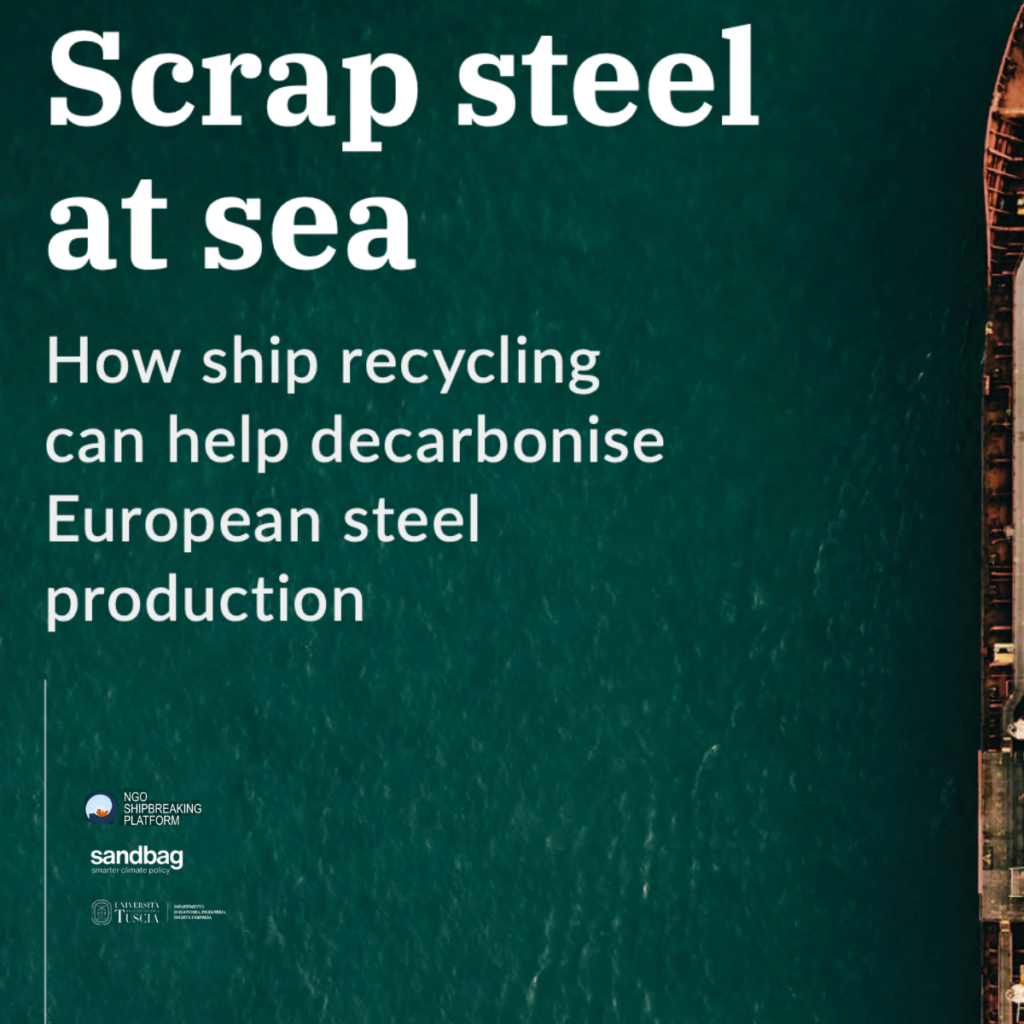
Scrap Steel at Sea: How ship recycling can help decarbonise European steel production
As Europe seeks to decarbonise its steel industry, a new Sandbag report highlights an overlooked solution: high-quality scrap steel from retired ships. With up to 15 million tonnes of certified scrap available annually, ship recycling could meet 20% of EU steel scrap demand — if policy gaps are addressed.
Sandbag’s feedback to the call for evidence on the Circular Economy Act
Sandbag welcomes the Circular Economy Act (CEA) as an important step to accelerate the transition to a circular economy in the EU. Progress in this area has been slow and this act is sorely needed to address systemic issues holding back circularity, including the current fragmented approaches across Member States.
Electrification or electrical decarbonisation? We need both!
We agree with the European Commission’s general diagnosis that increasing the share of electricity in overall energy consumption is necessary to achieve deep decarbonisation. However, it is not sufficient. If overall energy use increases, or if electricity generation does not decarbonise rapidly, then electrification may fail its decarbonisation role.
Heat up industry, not the climate!
The European Commission has set out proposed terms and conditions for its auction on electrified /renewable industrial heat under the Innovation Fund (IF). We support the IF’s acknowledgment that indirect emissions are linked to the timing of electricity consumption rather than the source of electricity used. However, although it claims an intention to limit electricity use at hours of high marginal emission intensity, we are concerned that the proposed terms might lead to the opposite and significantly limit the scheme’s climate benefits.
Extending the CBAM to indirect emissions
The European Commission is considering amending the Carbon Border Adjustment Mechanism (CBAM) to include indirect emissions of CO2 from the use of electricity in the manufacturing of CBAM-covered goods.
New Principles for Steel Labelling: response to the consultation on the Industrial Decarbonisation Accelerator Act
Sandbag’s response to the EU’s Industrial Decarbonisation Accelerator Act sets out four principles to guide green steel labelling schemes, promoting credible standards based on lifecycle emissions and system-wide decarbonisation.
Getting Electrification Right: The broader challenge of induced emissions
This report examines how the climate impact of electricity use is shaped not just by its source, but also by its timing and location. It evaluates the EU’s RED III framework and associated hydrogen targets, using the RFNBO standard as a case study. The analysis shows that ill-timed use of renewable electricity (particularly for hydrogen production) can inadvertently drive fossil generation. It argues for more strategic use of electricity to avoid these unintended consequences and support genuine decarbonisation.