This new briefing from Sandbag explores approaches to labelling “green steel” products and proposes a methodology that would provide strong incentives for decarbonisation in the steel sector.
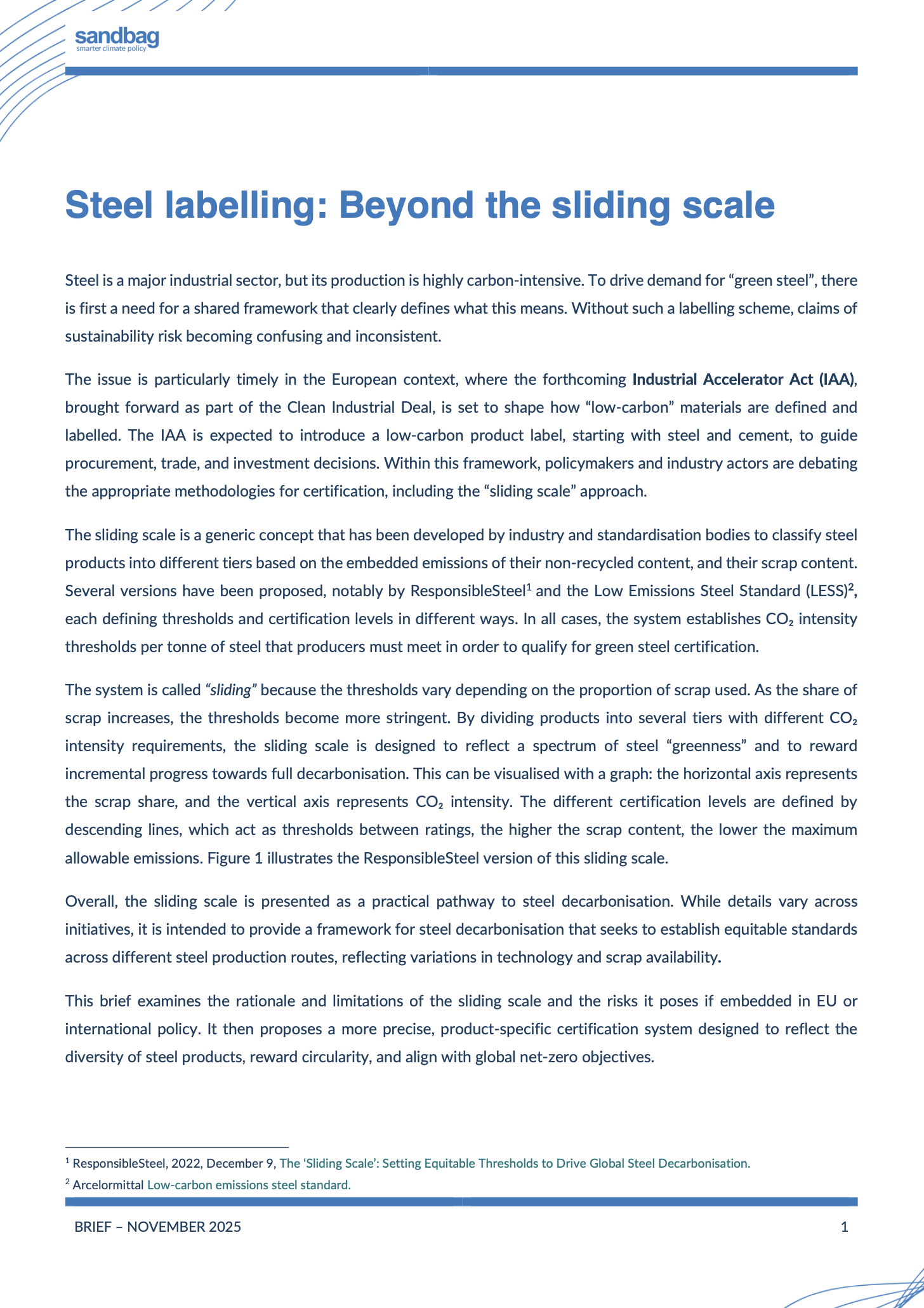
Steel is a major industrial sector — but its production is highly carbon-intensive. As policymakers seek to drive demand for “green steel,” the sliding scale approach has emerged as a candidate for low-carbon labelling, offering a simple framework based on emissions and recycled content. However, Sandbag’s latest technical brief finds that this approach risks distorting incentives, overlooking product diversity, and undermining circularity. We propose a more robust, product-specific alternative to ensure certification systems support real progress toward decarbonisation.
About the technical brief
This technical brief is published as the EU prepares its Industrial Accelerator Act (IAA), a flagship policy under the Clean Industrial Deal that is expected to introduce new product labelling for carbon-intensive materials such as steel and cement. As certification systems are developed to guide procurement and investment, the “sliding scale” approach is being widely debated. Sandbag’s brief unpacks the logic behind the sliding scale, highlights its risks, and sets out a more effective approach grounded in product-specific emissions benchmarks and circular economy principles.
Key findings
- Sliding scale methods distort incentives
By tying emissions thresholds to scrap content, the sliding scale can create perverse incentives — rewarding producers for using less scrap, even if this leads to higher total CO₂ emissions.
- Lack of product differentiation skews outcomes
The sliding scale applies uniform thresholds that do not reflect the diversity of steel products or production routes. Products requiring high-quality inputs, such as flat steel or high-strength steels, can be unfairly penalised.
- Circularity and transparency are undermined
The current system does not distinguish between pre-consumer and post-consumer scrap and may encourage downcycling. This obscures real emissions and discourages closed-loop recycling of high-quality materials.
- Sandbag proposes a product-specific certification model
The brief introduces a new system built on product-specific benchmarks, a multi-tiered rating structure, and a downcycling adjustment to fairly account for scrap type and use.
- A future-proof approach with broader sustainability potential
Sandbag’s model includes a sliding time factor, allowing benchmarks to evolve in line with global climate targets. It also proposes a global sustainability indicator to incorporate environmental, social, and labour metrics alongside emissions.
In the News
LESS: Sliding-Scale Sagacity: Steel’s Sustainability Schism
December 11, 2025
Related Publications
July 14th 2025
More on steel

The Net Zero Industry Act: all industry, no net zero
The European Commission’s proposal for a Net-Zero Industry Act (NZIA) as part of the Green Deal...

The European Hydrogen Bank: a recipe for competitive distortion
Last Thursday, the European Commission published its Communication on the European Hydrogen Bank...
EU Criteria for Green Hydrogen: How They Could Increase Relience on Thermal Power and Hijack the Energy Transition
On February 13th 2023, the European Commission released two pieces of legislation to provide criteria defining renewable hydrogen products. The so-called Delegated Acts matter because they set out how to comply with other regulations under review which will force ships, aircraft and heavy industry to use a minimum content requirement of the fuel, such as the Renewable Energy Directive, REFuelEU Aviation and FuelEU Maritime.