
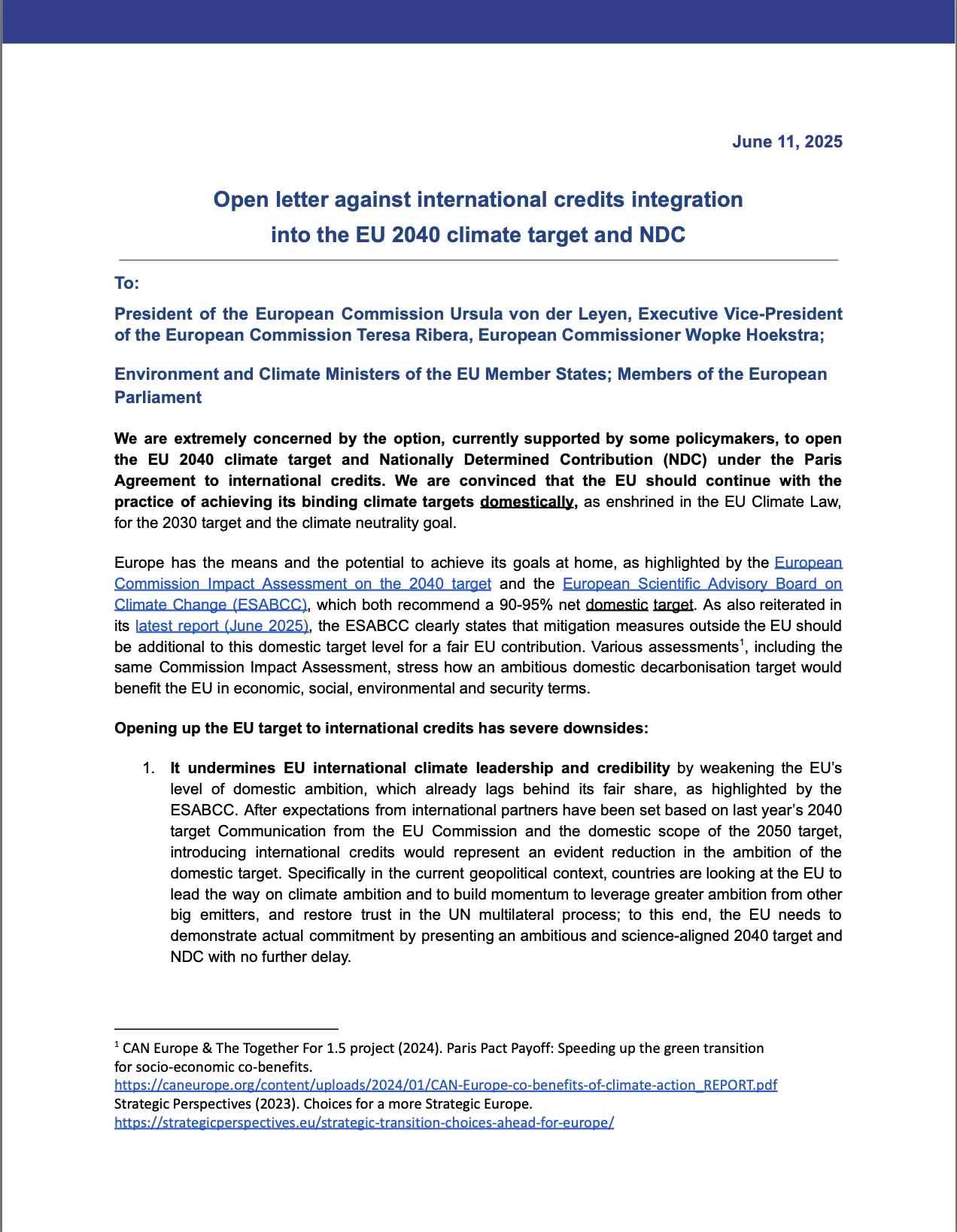
The signatories warn that shifting from domestic action to external offsets risks weakening EU climate ambition, undermining international credibility, and delaying essential structural change. The letter calls for a fully domestic, science-aligned target of at least 90% net emissions reductions by 2040.
About the open letter
The letter responds to growing political signals that international credits could be introduced into the EU’s 2040 climate framework. This would mark a major departure from the current EU Climate Law, which mandates that targets be met primarily through domestic action.
Key Findings
- Undermines EU climate credibility The inclusion of international credits would weaken the ambition of the EU’s domestic climate targets, risking the erosion of its hard-won leadership on climate action.
- Environmental and human rights risks Article 6 credits have been linked to weak safeguards and real-world abuses. Early deals under this framework show troubling signs of poor quality and unverifiable emissions savings.
- Fails to deliver real emission reductions Offsets only shift emissions elsewhere and delay structural decarbonisation at home. A systemic review found that just 16% of credits reflected actual emissions cuts.
- Not a form of climate finance Buying credits does not constitute a climate finance contribution. It is a financial transaction — not a substitute for real EU action.
- Increases long-term costs and uncertainty Relying on credits would mean recurrent costs and financial outflows, locking in polluting investments and stranding future assets.
Related publications
More on the 2040 climate target

Simulating CDR in the EU ETS: The Risks of Premature Integration
Sandbag has developed an ‘ETS + CDR simulator’ to help visualise and explore the impact that CDR integration could have on the ETS, assess the demand it could create for CDR, and highlight the potential consequences of this demand. This report uses the simulator to explore how different integration pathways could affect emissions reductions, carbon prices, and potentially lead to negative externalities.

The EU ETS at a Crossroads
Sandbag’s latest submission to the EU ETS and Innovation Fund consultation calls for clearer rules on free allocation, stronger criteria for funding innovation, and safeguards against misleading carbon accounting practices.

In or Out: What’s best for carbon removals and the EU ETS?
What will the future of the EU Emissions Trading System (ETS) look like as the emissions cap heads towards zero? Is integrating carbon dioxide removals (CDRs) into the ETS a solution to help the EU achieve its climate goals? Or would they compromise the integrity and functioning of the system? These questions are at the forefront of the Commission’s mind as they review different options for the future of the ETS ahead of the 2026 revision.