
Report - A Scrap Game: Impacts of the EU Carbon Border Adjustment Mechanism
The Carbon Border Adjustment Mechanism (CBAM) was formally adopted on 17 May 2023, two years after the initial proposal by the European Commission. We are now in the midst of the CBAM transitional period and negotiations are continuing for its full entry into force in January 2026.
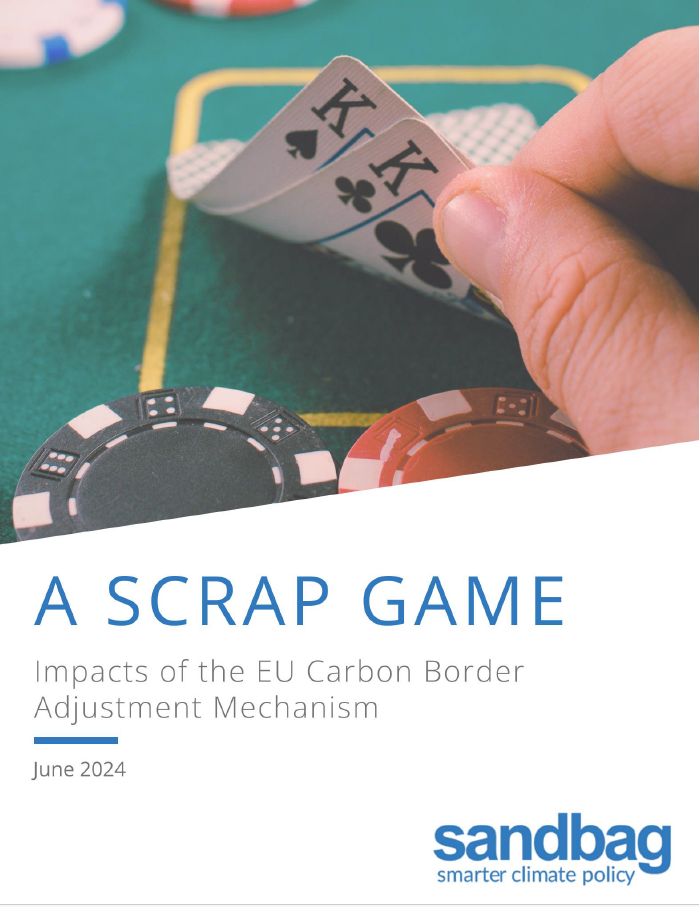
Our new report A Scrap Game: Impacts of the EU Carbon Border Adjustment Mechanism brings together the latest information on legislative progress and provides an update to our previous report. Our analysis focuses on the CBAM’s impacts for the EU’s main trade partners, in particular China.
Here are the key results of our analysis:
- The impacts of the CBAM for EU trade partners will be much less negative than often assumed:
- The CBAM fees applicable to Chinese goods, for instance, may represent just 0.12% of the total value of goods imported into the EU from China.
- In addition, importers will benefit from higher selling price in the EU, thanks to the phasing out of free allocation under the EU ETS.
- When this is factored in, some imports of CBAM goods (steel, aluminium, etc.) may become more profitable.
- Conversely, EU industries using CBAM goods (automotive, wind turbines…) will bear higher costs
- Imports of products down the value chain will become more competitive
- EU exports will become less competitive
- The impact on trade partners depends on their reaction to the CBAM:
- In a “business-as-usual” scenario, where they only pay the fee without changing processes, the net cost is €245 million for Chinese importers (0.05% of total Chinese imports).
- In a “resource-shuffling” scenario, with only marginal changes to production processes, importers of Chinese goods make a net profit.
Main takeaways
- The climate benefit is immense: thanks to the CBAM, 43% of free allowances can be removed from the EU ETS which will at last incentivise emission reductions in highly polluting sectors.
- It could have been higher, as many exemptions were granted up the value chains (“precursors”).
- But the EU is taking a risk, as trade partners may use loopholes to outcompete its industry.
- Those loopholes can be closed at a later stage, so those strategies might not pay off in the long run.
This new report builds upon the analysis we conducted in 2021 together with climate think tank Third Generation Environmentalism (E3G) in a report titled A Storm in a Teacup: Impacts and Geopolitical Risks of the European Carbon Border Adjustment Mechanism.
In the news
- Africa Confidential: A disputed levy
- Agence Europe: CBAM could affect European producers more than importers, according to a report by Sandbag
- Bloomberg: EU’s Carbon Border Levy Risks Backfiring on Industry, Study Says
- Carbon Pulse: EU’s CBAM may hurt bloc’s manufacturers more than int’l ones -NGO
- ENDS Europe: EU producers must ‘squeeze’ margins to remain competitive under CBAM, report warns
- EUObserver: EU carbon border tax will have ‘very small impact’ on China, new report finds
- Montel News: CO2 border tax may have minimal impact – study
- Journal of Environmental Policy & Planning: The European Union’s CBAM: averting emissions leakage or promoting the diffusion of carbon pricing?
Download our report:
Download the executive summary:
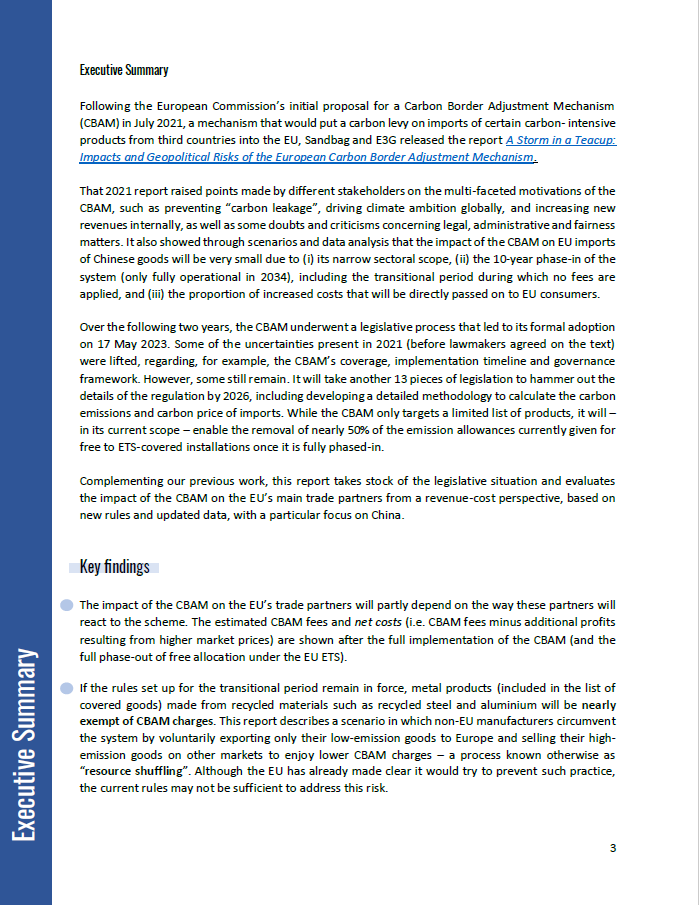
Photo by Michał Parzuchowski on Unsplash
Read More:
CBAM impact on US trade: an analysis
Sandbag’s September 2025 research note explores the impact of the EU’s CBAM on US exports. It finds that even with expanded scope, the financial impact remains marginal, and US carbon pricing could turn net costs negative.

The EU CBAM: A Two-Way Street to Climate Integrity?
Supported by the Konrad-Adenauer-Stiftung, Sandbag’s report examines the impact of the EU’s Carbon Border Adjustment Mechanism (CBAM) and the gradual removal of free allowances on third-country exporters. The joint implementation is expected to raise production costs for both EU and non-EU producers, leading to higher prices for CBAM-covered goods in the EU.
Strengthening the CBAM — by default
The consultation aims to address concerns that the CBAM has loopholes that could distort competition between products manufactured in the EU (covered by the EU ETS) and imported goods. Our response sets out proposals for how the design of the CBAM could be improved in these regards.