


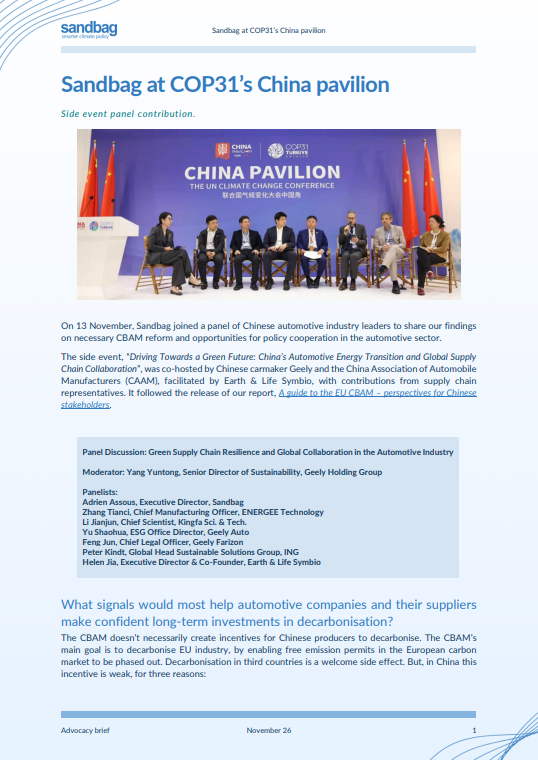
Moderator: Yang Yuntong, Senior Director of Sustainability, Geely Holding Group
Panelists:
Adrien Assous, Executive Director, Sandbag
Zhang Tianci, Chief Manufacturing Officer, ENERGEE Technology
Li Jianjun, Chief Scientist, Kingfa Sci. & Tech.
Yu Shaohua, ESG Office Director, Geely Auto
Feng Jun, Chief Legal Officer, Geely Farizon
Peter Kindt, Global Head Sustainable Solutions Group, ING
Helen Jia, Executive Director & Co-Founder, Earth & Life Symbio
What signals would most help automotive companies and their suppliers make confident long-term investments in decarbonisation?
The CBAM doesn’t necessarily create incentives for Chinese producers to decarbonise. The CBAM’s main goal is to decarbonise EU industry, by enabling free emission permits in the European carbon market to be phased out. Decarbonisation in third countries is a welcome side effect. But, in China this incentive is weak, for three reasons:
1. The CBAM affects only a small share of Chinese production
China’s steel exports to Europe amounted to 9m tonnes in 2025, equivalent to 0.9% of the country’s total steel production. For aluminum, Chinese exports to the EU amount to 0.6m tonnes, or 0.8% of the country’s total aluminum production.
And this small amount of steel is not all for the automotive sector. Flat steel products make up about 80% of steel used in a combustion-engine car and 88% in an electric vehicle, but only 3m tonnes of CBAM imports are flat-steel or derived thereof, or 0.3% of exports.
The European Parliament has proposed adding 457 products to the CBAM’s scope, about 100 of which are closely related to the automotive sector. But even with that extension, CBAM-covered automotive goods would amount to less than 0.6% of China’s steel production.
2. The Waterbed effect (resource shuffling)
The EU’s CBAM creates an incentive for carmakers to source components with the lowest emission intensity. It does not necessarily reward their suppliers for investing in cleaner production processes.
3. Contradictory incentives
Steel made in an electric arc furnace (EAF) running on coal-fired electricity may emit more CO2 than steel from a blast furnace. Despite the higher emissions intensity, the CBAM does not charge for the carbon embedded in the electricity used, thereby potentially rewarding more polluting processes.
This matter needs to be resolved quickly because, as this COP is showing, electrification is coming.
Our proposals for the EU’s CBAM:
- Resource shuffling incentives should be addressed, for example by using systematic default values or by implementing a Chinese ETS equivalent to the EU’s.
- Indirect emissions should also be included into the scope of the EU’s CBAM.
For EV supply chains connecting China and Europe, where would practical cooperation most help low-carbon or recycled materials gain wider market acceptance?
Market acceptance is challenging for several reasons:
- Manufacturers that purchase green steel voluntarily hurt their profits, unless they pass the additional costs on to customers willing to pay a premium.
- The public sector rarely purchases automotive goods.
- On paper, some end users might be willing to pay more for cars made with green steel, because the price premium is relatively small. Assuming a 50% green steel premium on a €32,000 car, the additional cost is €891 (0.9%).
- Even for customers willing to pay a premium, green claims are difficult to verify in such a complex industry:
- transparency over the supply-chain is made difficult as there are a multitude of intermediate production steps and suppliers;
- recycling rates are easier to achieve for long steel than for flat steel, and for low-strength steel than for high-strength steel;
- resource shuffling means that purchasing “green” products might simply reallocate products rather than provide any environmental gain.
Regulation may therefore be a better driver than market acceptance. Regulation would greatly benefit from cooperation:
1. Setting product design requirements
The quality of steel scrap produced with end of life electric vehicles is lower than that produced with combustion-engine cars. This is because electric copper wires are more intricated with steel auto parts. The EU and China should agree on design requirements for the recyclability of cars, not just reward their recycled content.
2. Making the CBAM effective
The automotive sector has complex value chains, which makes it difficult to monitor and report actual emissions. Reporting could rely on default values instead. Currently, default values are optional and usually set quite high, to prevent declarants from choosing the option most favourable to them. An agreement could be reached between the EU and third countries to adopt mandatory but less punitive default values.
Related publications
More on the CBAM
A guide to the EU CBAM – perspectives for Chinese stakeholders
This report reveals the implications of the EU’s CBAM for Chinese firms and outlines ways that Chinese firms can address relevant challenges.
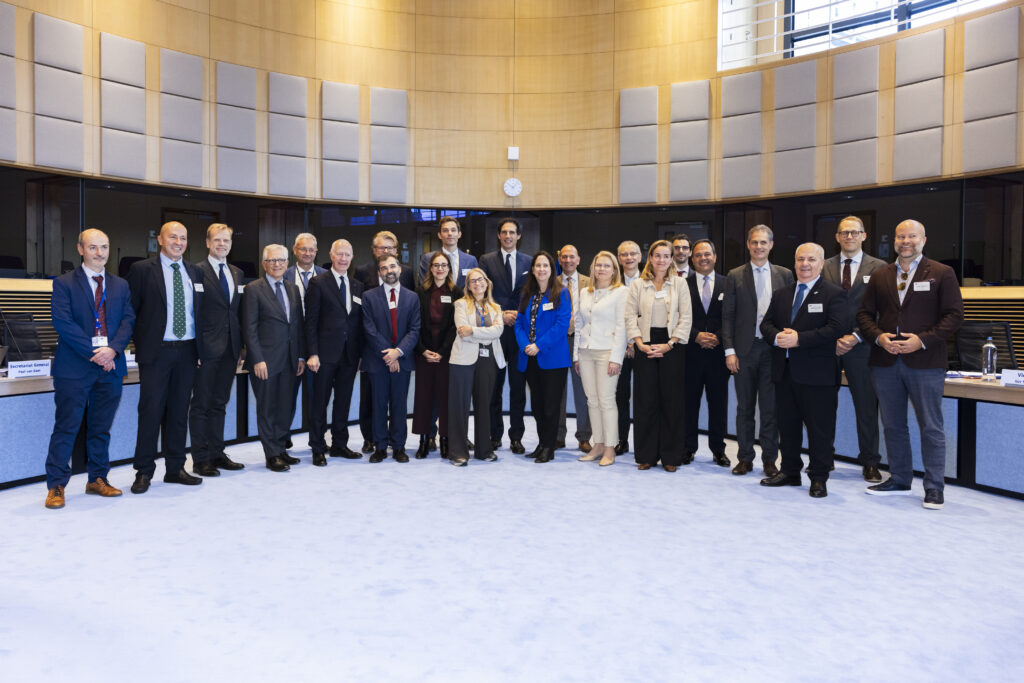
Sandbag at Wopke Hoekstra’s CBAM Implementation Dialogue
On 15 October 2026, Sandbag’s Adrien Assous had the honour of participating in a CBAM Implementation Dialogue organised by Commissioner Wopke Hoekstra.
The CBAM’s real impact on India
This report makes a granular assessment of India’s ability to remain competitive in the EU market under the CBAM.
Webinar: The CBAM’s real impact on India
Our webinar aims to present and discuss our upcoming report on the CBAM’s impact on India and introduce our updated CBAM simulator.
Whether the carbon price is right: response to the European Commission’s public consultation on carbon price paid in third countries
Sandbag’s response to the European Commission’s public consultation on the carbon price paid in third countries under the CBAM.

Carbon pricing trends in Asia
This report by Carbon Market Watch, with analysis by Sandbag, examines potential CBAM costs for Japan, South Korea, Vietnam, Indonesia, and the Philippines, based on their trade exposure, production outlooks, and progress toward implementing a domestic carbon price signal.
An opt-in solution to CBAM circumvention and complexity
Our position paper on the Commission’s legislative proposal amending the CBAM proposes an opt-in solution to CBAM circumvention and complexity.
The EU CBAM gives a boost to Algeria’s iron exports
Sandbag’s brief assesses how the EU Carbon Border Adjustment Mechanism (CBAM) may affect Algeria’s iron and steel exports. It finds that although Algeria’s overall exposure to CBAM is limited, rising EU carbon costs are likely to increase EU market prices, with implications for the revenues and competitiveness of Algerian exports.
CBAM and Fertiliser Inflation in 2026: The facts behind the numbers
Estimates suggesting that the EU’s Carbon Border Adjustment Mechanism (CBAM) could increase fertiliser prices by up to 30% have brought a central question into focus: how significant is the inflationary impact likely to be?
The CBAM dividend for Namibia and Ghana
This research note shows that Namibia and Ghana are likely to benefit from the CBAM, as EU price increases linked to the EU ETS outweigh CBAM fees under current exports. It also sets out transparent transformation scenarios, based on announced industrial projects, to show how expanded and lower-emissions production could further increase export revenues over time.