

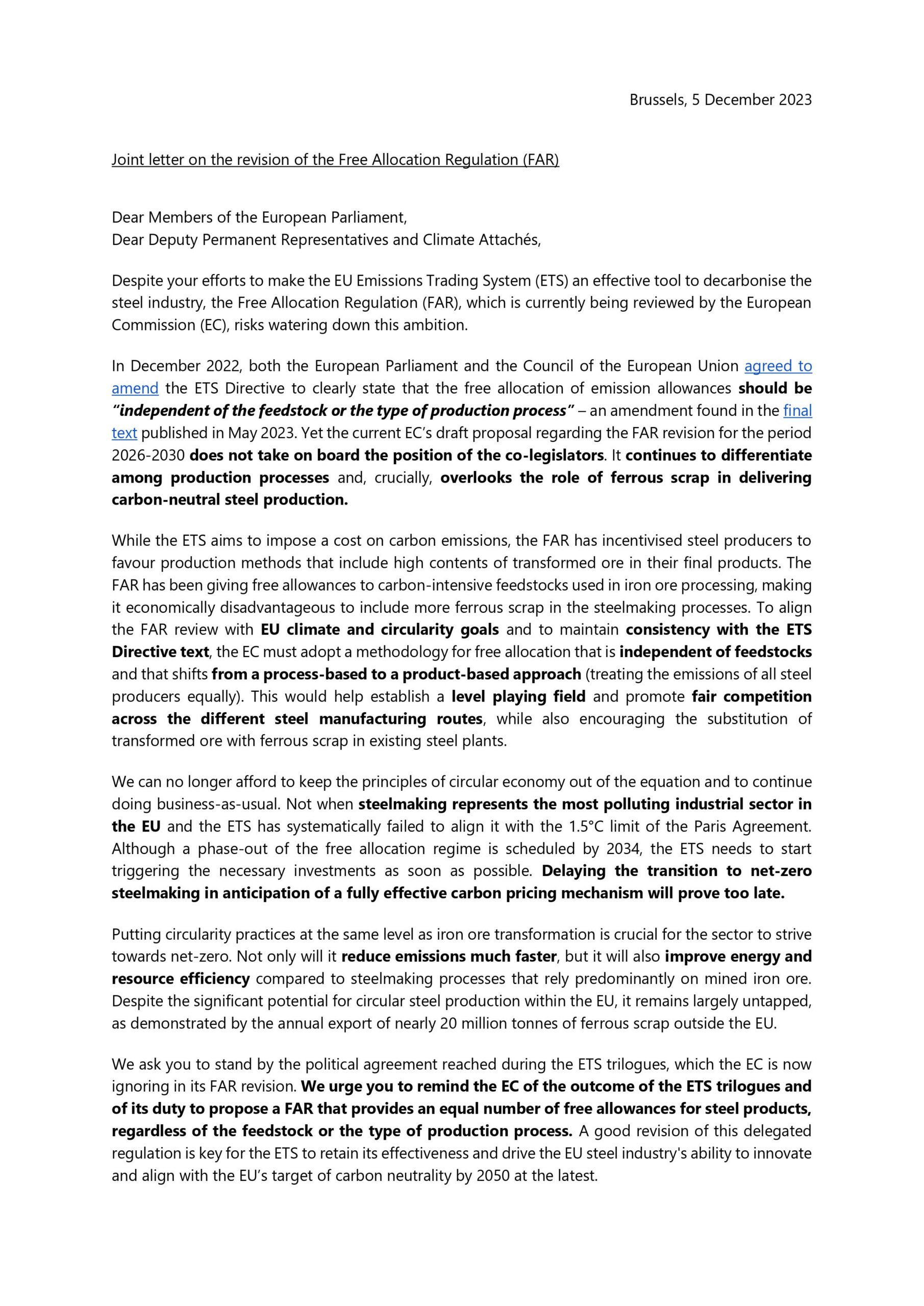
The proposed FAR rewards steel plants using transformed virgin ores (hot metal and direct reduced iron) with free emission permits, but by doing so, penalises those using recycled scrap. This contradicts the political mandate that the Parliament and the Council gave to the Commission. The revised EU ETS Directive, clearly stated that free emission allowances should be distributed in a way that is “independent of the feedstock or the type of production process” (Recital 10), yet the draft legal act published yesterday by the Commission continues to discriminate between feedstocks in steelmaking.
The revision of the Free Allocation Regulation is the last chance to fix a system that continues to reward the most carbon-intensive steel production methods. The allocation method of free permits needs to –and still can – be fixed. We and the 12 other signatories of this joint letter call upon the co-legislators to react while there is still time, and ask the Commission to take our concerns into consideration as part of the ongoing public consultation. We hope to see this issue resolved in the final draft of the revised FAR.
A solution to fix the hot metal/DRI benchmark
Sandbag developed a proposal to improve the free allocation method. It only affects the hot metal/DRI benchmark proposed by the Commission and would not change, on average, the number of free allowances received by steel plants. We have submitted this proposal to the Expert Group on Climate Change Policy, tasked with advising the Commission on the revision of the FAR.
Read More:
Sandbag responds to Thyssenkrupp
Our technical brief on how the ETS is a net benefit for European steelmakers was covered by ESG.Table, alongside a response from Thyssenkrupp Steel, which raised three objections. This response analyses the German steelmaker’s claims.
EU steelmaking: the ETS money is coming!
This brief challenges recent industry claims that EU steelmakers are being harmed by the EU’s Emissions Trading System and finds that the opposite is true.

Steel labelling: Beyond the sliding scale
As EU policymakers debate how to certify low-carbon steel, Sandbag’s new briefing analyses the “sliding scale” method — and outlines why it may hinder rather than help decarbonisation. A new model is proposed based on product-specific benchmarks, multi-tier ratings, and circularity incentives.