

This report reveals the implications of the EU’s CBAM for Chinese firms and outlines ways that Chinese firms can address relevant challenges.
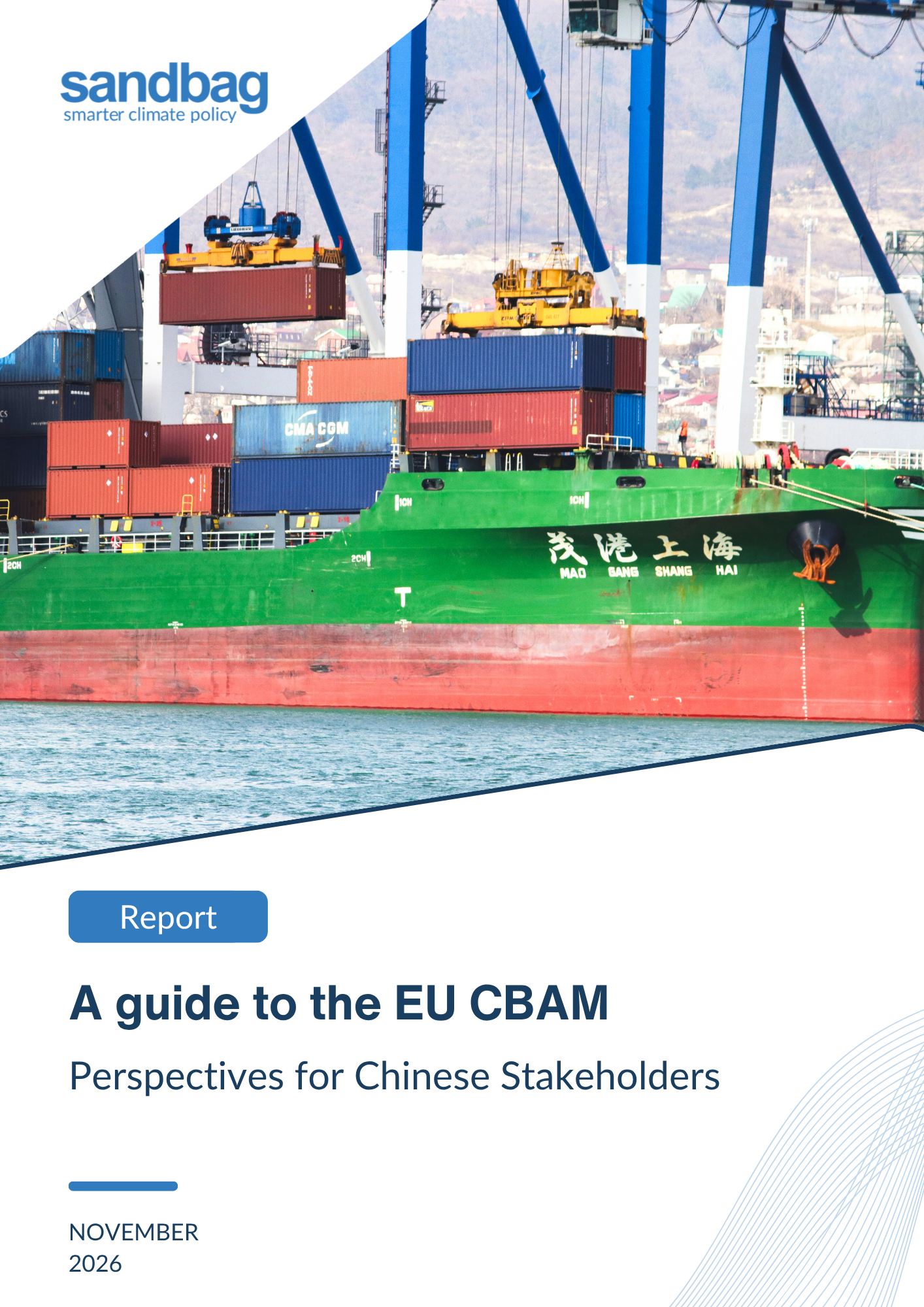
A Chinese version of this report will be made available soon.
Executive Summary
The EU’s Carbon Border Adjustment Mechanism (CBAM) was created to replace the free allocation of emission permits in the EU’s carbon market, as protection against competition from countries with lower carbon costs.
Despite being fully in force since January 2026, imposing carbon fees to imports, the legislation is still being finalised. In addition, changes in its scope and rules are already being proposed for 2028; with additional changes likely to be adopted in the future.
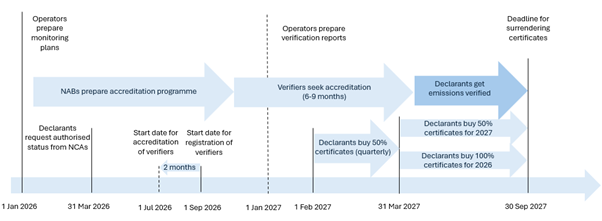
Figure 1: Timeline of CBAM compliance
This report reviews the challenges to Chinese firms and ways of addressing them:
- Availability of verifiers doing site visits in China: firms already accredited for the EU ETS will get fast-track approval, and Chinese entities (including, but not only branches of EU-based firms) can be entrusted by accredited firms.
- Discounts for carbon price paid will be very small: allowances (and CCERs) paid in the National ETS will likely be discounted due to free allocation; Green Certificates will not be eligible.
- Timing: monitoring plans should be prepared now. New guidance documents were published on 14 August 2026. If using precursors, manufacturers should preferably source those precursors from firms directly exposed to the EU market.
- For flat steel goods, default values may be less costly than actual data below 550 tonnes exported (annually) in 2026 and 350 tonnes in 2034.
- Hedging: in case of failed MRV, importers may pass their volume liabilities to suppliers through contractual clauses.
- Confidentiality: for risk management purposes, importers might require detailed emission reports from suppliers, even though this is not required for CBAM declarations. This can be avoided if risk is fully covered, e.g., by cash deposits or bank guarantees.
- Circumvention: although some reallocation channels still exist, the EU is gradually closing them.
- Decarbonisation should turn CBAM costs into revenues.
At country level, we have assessed the impact of the CBAM on Chinese imports to the EU in various configurations of the CBAM: 1) its current scope; 2) its extension to 180 downstream products, as proposed by the European Commission; 3) to chemicals, polymers, and refinery products; 4) the extension of its emissions scope to pre-consumer metal scrap, as proposed by the Commission; and 5) to indirect emissions.
In 2025, China exported 11.2m tonnes of CBAM goods to the EU across 559 products. After full ramp-up of the CBAM (in 2034), in a scenario where exported goods have the national average emissions intensity, we estimate annual CBAM fees due on these products to be 1,385 million euros. The downstream extension proposed by the European Commission to 180 new products would add 5.9m tonnes of goods into the CBAM scope, across 169 products and 632 million euros to the CBAM bill.
However, CBAM fees are only one side of the story. Thanks to the expected price rise in EU markets with the phasing out of free emission permits for domestic producers, revenues will also increase for importers, with a lower net cost for Chinese CBAM imports of 935 million euros. Net costs would also increase by a more modest 352 million euros, if the proposed downstream extension was adopted.
Ultimately, compliance costs can be reduced by ensuring that the embedded emissions of exported goods are as low as possible. China’s CBAM-covered exports only represent 0.8% (2.5 million tonnes) of the country’s flat steel production – a share that would barely reach 1.5% if downstream goods were included. Innovative low carbon projects such as Baowu’s Zhanjiang hydrogen-ready DRI plant with 1m tonne capacity could, if blended with 50% scrap, almost cover the entire country’s EU exports.
In a scenario where the most innovative or lowest carbon products are dedicated to EU exports, annual CBAM fees would fall to 303 million euros and net costs would turn negative, i.e. a benefit, at -147 million euros.
Related publications
More on the CBAM
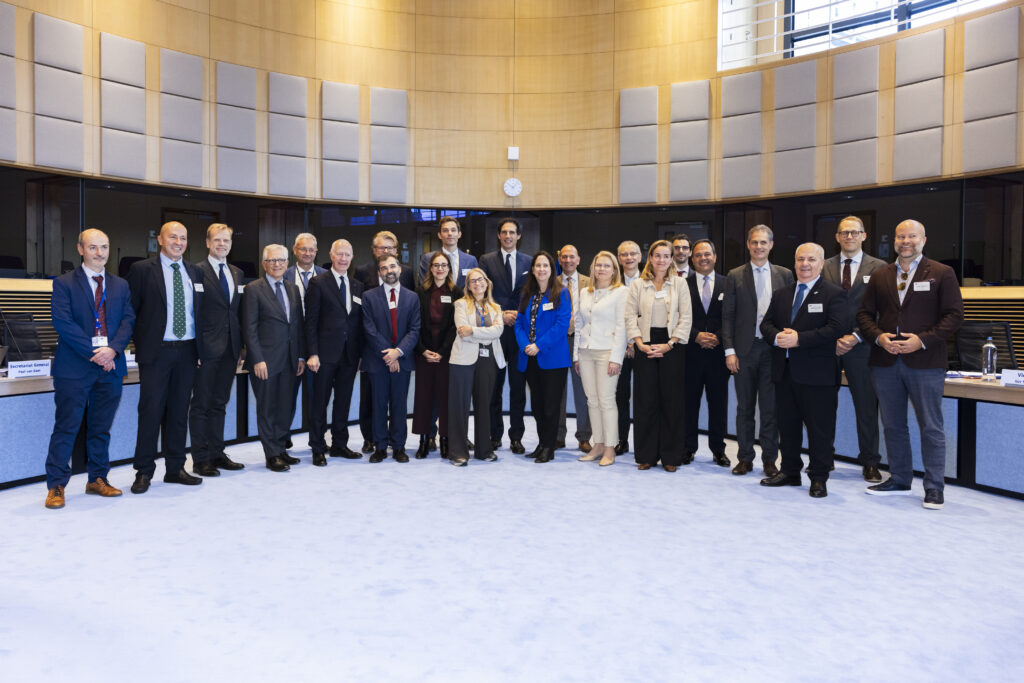
Sandbag at Wopke Hoekstra’s CBAM Implementation Dialogue
On 15 October 2026, Sandbag’s Adrien Assous had the honour of participating in a CBAM Implementation Dialogue organised by Commissioner Wopke Hoekstra.
The CBAM’s real impact on India
This report makes a granular assessment of India’s ability to remain competitive in the EU market under the CBAM.

Webinar: The CBAM’s real impact on India
Our webinar aims to present and discuss our upcoming report on the CBAM’s impact on India and introduce our updated CBAM simulator.
Whether the carbon price is right: response to the European Commission’s public consultation on carbon price paid in third countries
Sandbag’s response to the European Commission’s public consultation on the carbon price paid in third countries under the CBAM.

Carbon pricing trends in Asia
This report by Carbon Market Watch, with analysis by Sandbag, examines potential CBAM costs for Japan, South Korea, Vietnam, Indonesia, and the Philippines, based on their trade exposure, production outlooks, and progress toward implementing a domestic carbon price signal.
An opt-in solution to CBAM circumvention and complexity
Our position paper on the Commission’s legislative proposal amending the CBAM proposes an opt-in solution to CBAM circumvention and complexity.
The EU CBAM gives a boost to Algeria’s iron exports
Sandbag’s brief assesses how the EU Carbon Border Adjustment Mechanism (CBAM) may affect Algeria’s iron and steel exports. It finds that although Algeria’s overall exposure to CBAM is limited, rising EU carbon costs are likely to increase EU market prices, with implications for the revenues and competitiveness of Algerian exports.
CBAM and Fertiliser Inflation in 2026: The facts behind the numbers
Estimates suggesting that the EU’s Carbon Border Adjustment Mechanism (CBAM) could increase fertiliser prices by up to 30% have brought a central question into focus: how significant is the inflationary impact likely to be?
The CBAM dividend for Namibia and Ghana
This research note shows that Namibia and Ghana are likely to benefit from the CBAM, as EU price increases linked to the EU ETS outweigh CBAM fees under current exports. It also sets out transparent transformation scenarios, based on announced industrial projects, to show how expanded and lower-emissions production could further increase export revenues over time.
Chemicals in the CBAM: Time to step up
Sandbag’s latest brief explains why the EU CBAM must be expanded to cover key chemical value chains. With chemicals and refinery products responsible for 30% of industry emissions, phased inclusion is critical to prevent carbon leakage and phase out free allowances.