
Industrial heat electrification is a key strategy for decarbonising energy-intensive industries by replacing fossil-based heat. We welcome the European Commission’s initiative to launch an auction to electrify industrial heat, while emphasising the need for careful design to prevent unintended increases in emissions due to electricity grid dynamics.
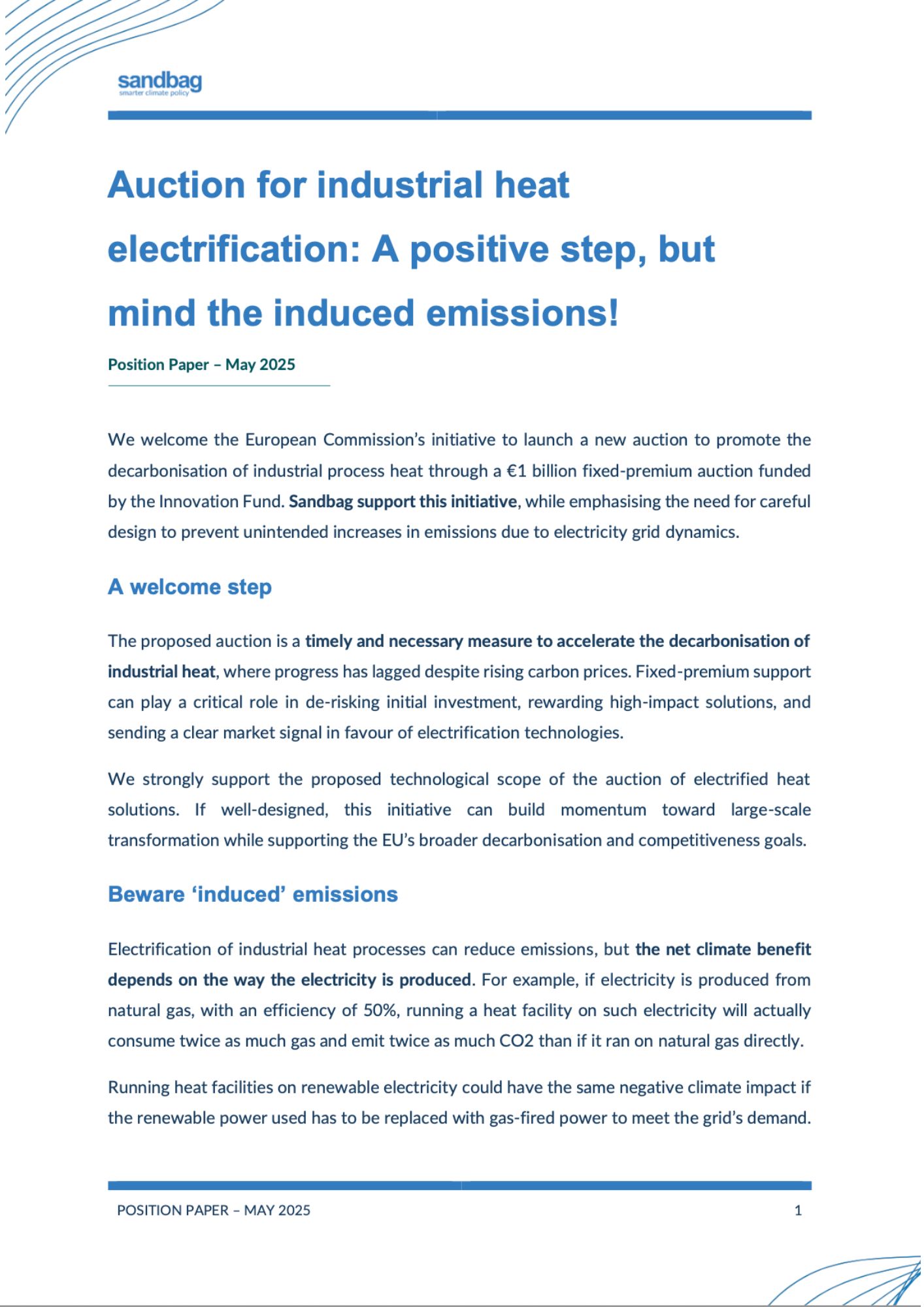
About the position paper
This position paper sets out our feedback on the proposed new €1 billion fixed-premium auction under the Innovation Fund, which is aimed at accelerating the decarbonisation of industrial process heat. We welcome the proposal and suggest how the auction can be designed to maximise emission reductions from the scheme.
Key findings
Industrial heat decarbonisation needs urgent support
The auction is a timely measure to help overcome current investment barriers and signal strong support for electrification technologies.
Emissions impact depends on marginal electricity generation
The net climate benefit of electrification depends significantly on the marginal generation source supplying the grid at the time of electricity use, with risks of increased emissions if fossil fuels are supplying the marginal demand.
Efficiency-based baskets improve auction effectiveness
Dividing auction projects by energy efficiency and applying tailored safeguards prevents incentives for high-emission operations and promotes genuine emissions reduction.
This new auction to promote the decarbonisation of key industrial processes is a welcome step. To maximise the impact of the industrial heat electrification auction and support the EU’s climate goals, we recommend that:
Robust safeguards are in place to avoid unintended emission increases caused by electricity grid dynamics.
Efficiency-based baskets are used to ensure that subsidies reward genuine emissions reductions.
Subsidy payments are limited during times when fossil-fuel power plants set the marginal electricity price.
The auction design strikes a balance between accelerating decarbonisation and maintaining grid stability.
With these measures, the auction can be a strong step towards a cleaner and more competitive industrial sector.
Read the full position paper to learn more.
Photo by rsaraiva from Canva
Related publications
Aug 11th 2025
More on the Climate Finance
Extending the CBAM to indirect emissions
The European Commission is considering amending the Carbon Border Adjustment Mechanism (CBAM) to include indirect emissions of CO2 from the use of electricity in the manufacturing of CBAM-covered goods.
New Principles for Steel Labelling: response to the consultation on the Industrial Decarbonisation Accelerator Act
Sandbag’s response to the EU’s Industrial Decarbonisation Accelerator Act sets out four principles to guide green steel labelling schemes, promoting credible standards based on lifecycle emissions and system-wide decarbonisation.

The EU ETS at a Crossroads
Sandbag’s latest submission to the EU ETS and Innovation Fund consultation calls for clearer rules on free allocation, stronger criteria for funding innovation, and safeguards against misleading carbon accounting practices.