EU Emissions Trading System (ETS)
We conduct research on the EU Emissions Trading System (ETS) to make it efficient and effective at reducing emissions.
What is the EU ETS?
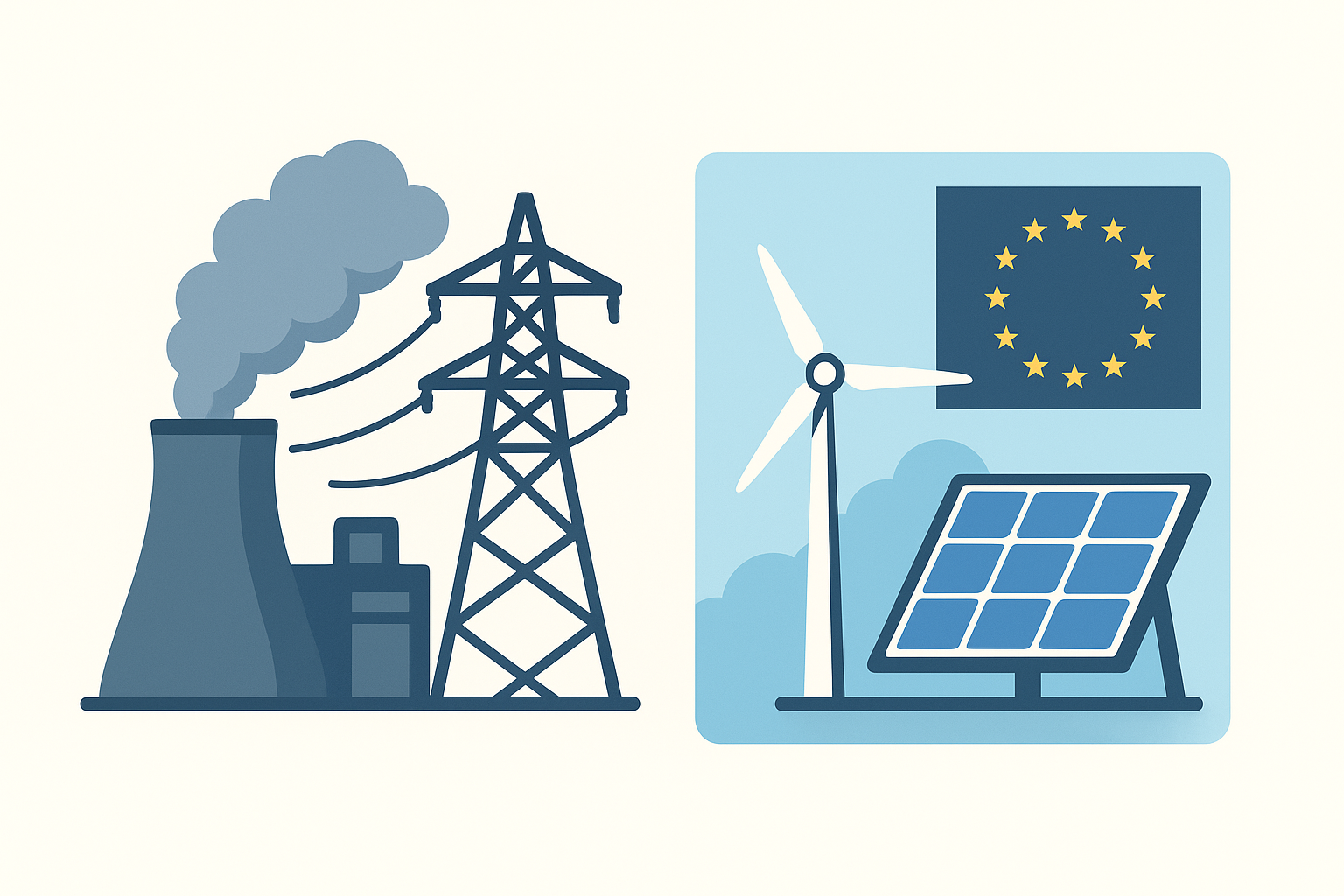
The EU ETS is the European Union’s flagship climate policy, designed to reduce greenhouse gas (GHG) emissions cost-effectively.
By creating a market of emission permits, it incentivises individual installations in sectors like power generation and heavy industry to cut emissions.
It was extended to the shipping sector in 2024 and is connected to an ETS covering aviation.
How does it work?
- Cap-and-trade system: A legal cap limits total emissions in sectors like power generation and heavy industry. This cap decreases annually to drive decarbonisation.
- Allowances and trading: Allowances are tradable, creating a carbon market. Companies must surrender one allowance per tonne of greenhouse gas (CO2, N20, PFC) emitted.
- Carbon price: Limiting allowance supply drives a market-based price, allowing factories to decarbonise cost-effectively.
Ongoing challenges
- Until 2018, an oversupply of allowances kept carbon prices very low, providing no incentive to cut emissions.
- Today, prices are higher but free emission allowances and state aid compensation for indirect carbon costs, continue to create unfair competition between polluting and less-polluting processes and products.
Our work
Our tools
We develop in-house tools to help policymakers and stakeholders understand and improve the EU ETS.
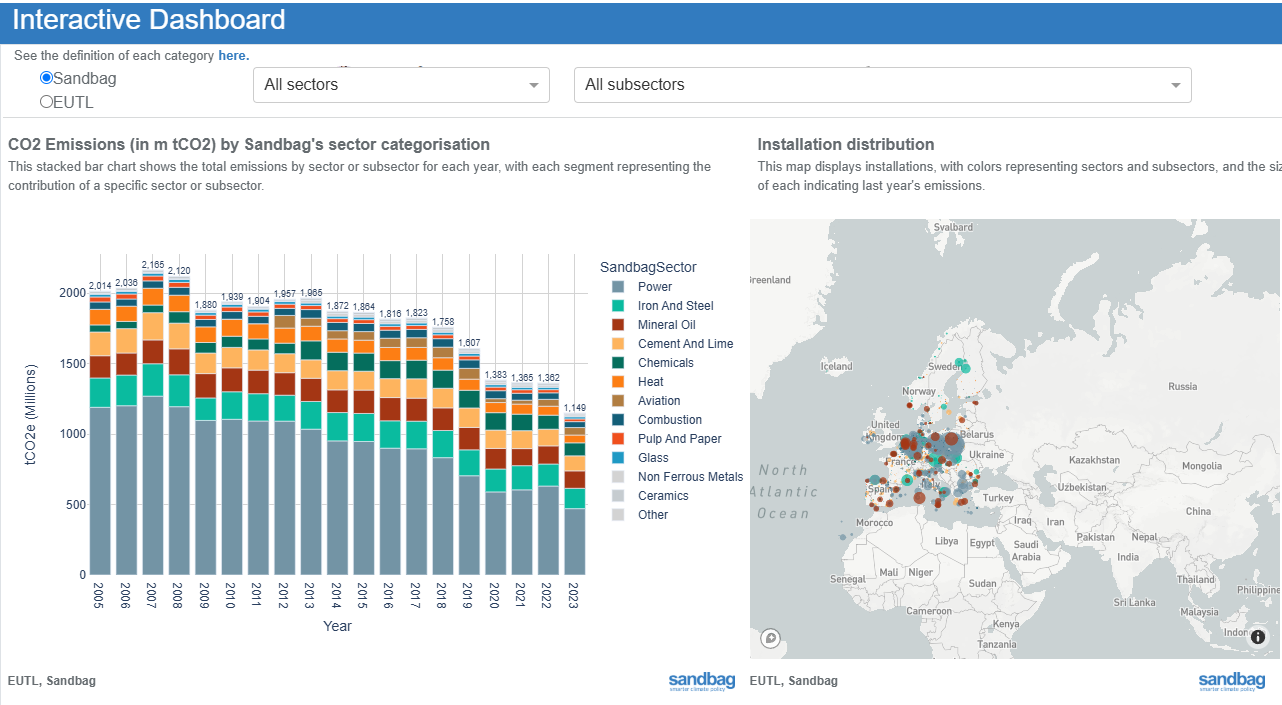
EU ETS Dashboard
Explore sector-specific emissions data within the EU Emissions Trading System at various levels of granularity.
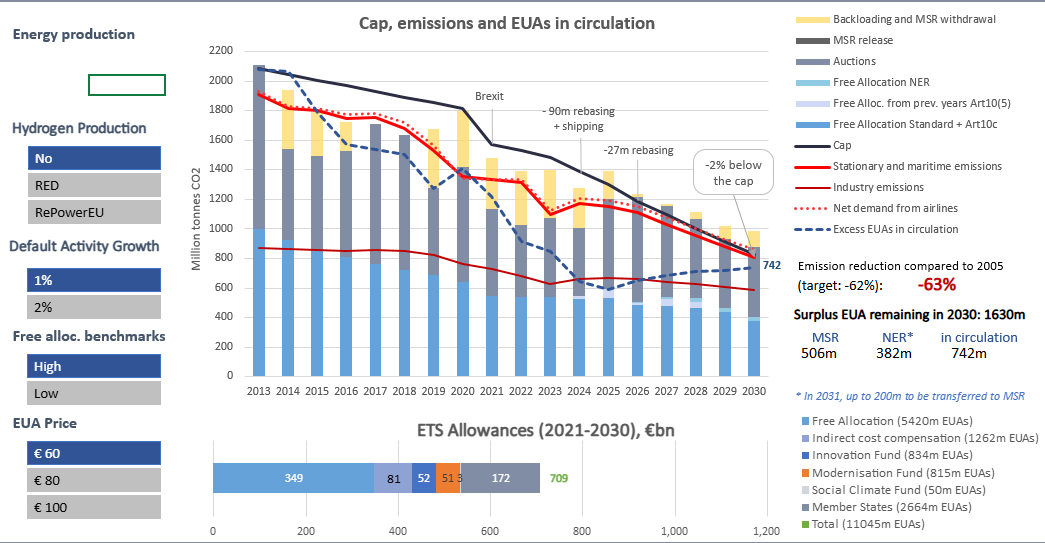
EU ETS Simulator
Analyse the impact of policy adjustments on the EU ETS.
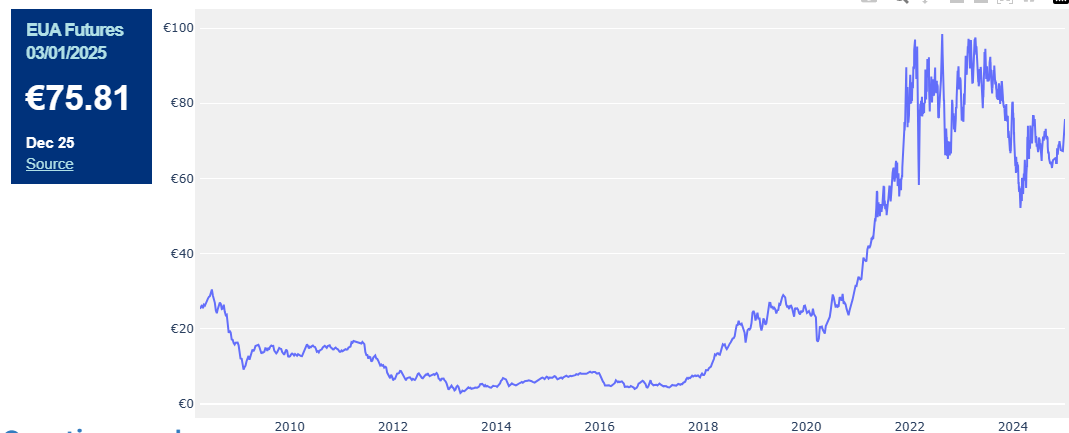
Carbon price viewer
Check and analyse the evolution of EU carbon price over time.
Latest publications on the EU ETS
We deliver data-driven and evidence-based policy recommendations though, direct feedback to institutions, reports and policy briefs.

Our achievements
February 2024: ETS benchmarks updated to reflect low-carbon production routes
In February 2024, ETS benchmarks were amended to better reflect emerging decarbonisation pathways, including the recognition of alternative binders in cement and direct reduced iron (DRI) in steel. These updates aligned with Sandbag’s long-standing analysis and technical input highlighting the need for ETS benchmarks to reflect low-carbon production routes, in order to improve investment signals for industrial decarbonisation.
Our messages
Keeping up with ambitions
The ETS cap is set to reach near zero by 2039 – an achievable goal, partly due to the large surplus of allowances already in the system. There is no need to weaken this ambition by lifting the cap or letting offsets in.
Phasing out free allocation quickly
Free allocation should be phased-out quickly, and accompanied by an efficient implementation of the Carbon Border Adjustment Mechanism (CBAM) to prevent carbon leakage. More about the CBAM.
Reforming free allocation
While it IS still on, free allocation should better level the playing field for – at least – some cleaner alternatives such as steel recycling.
Reforming compensation for indirect carbon costs
This State aid should support businesses for using intermittent renewable electricity rather than stable grid electricity.
Reforming the Innovation Fund
Public money from the Innovation Fund should be better spent. Grants should prioritise early-stage innovation, while mature technologies should only receive performance-based subsidies.
Read our latest publications
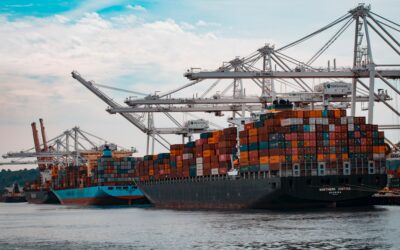
An Export Solution for a Faster CBAM Phase-in
A Carbon Border Adjustment Mechanism (CBAM) has been proposed by the European Commission as an...
Our concerns regarding ETS and CBAM legislative texts
We have strong concerns regarding the legislative texts on the revision of the Emissions Trading...
2nd ETS trilogue: EU institutions agreed on almost nothing, except on perpetuating free allocation for the steel giants
The second ETS trilogue took place last week on October 11th. Tabled proposals on benchmarks regarding the steel…
Get involved and support us towards this effort!
While these developments mark important progress, we need more profound changes for the EU ETS to effectively drive decarbonisation at the scale and pace required.

WHAT WE DO
TOOLS
PUBLICATIONS
NEWSLETTER
Mundo-b Matogné. Rue d’Edimbourg 26, Ixelles 1050 Belgium.
Sandbag is a not-for-profit (ASBL) organisation registered in Belgium under the number 0707.935.890.
EU transparency register no. 277895137794-73.
VAT: BE0707935890.